Mada za sehemu hiiNatural Groups Of OrganismMada 26
- General overview of classification
- Viruses.
- Kingdom Monera
- Kingdom Protoctista
- Phylum Rhizopoda
- Phylum Zoomastigna
- Phylum Apicomplexa
- Phylum Euglenophyta.
- Phylum Oomycota.
- Phylum Chlorophyta.
- Kingdom Fungi
- Phylum Zygomycota
- Phylum Ascomycota.
- Phylum Basidiomycota
- Advantages and disadvantages of the kingdom Fungi
- Kingdom Plantae
- Division Bryophyta.
- Division Filicinophyta (Pteridophyta).
- Division Coniferophyta (Conifers).
- Division Angiospermophyta (flowering plants)
- Kingdom Animalia
- Phylum Platyhelminthes
- Phylum Aschelminthes (Nematoda)
- Phylum Annelida.
- Phylum Arthropoda.
- Phylum Chordata
Phylum Zoomastigna
E.g. trypanosome
Characteristics
- They possess flagellum at some stages of their life cycle.
- They possess chromatophores (colored pigments).
- They have a definite shape and have pellicle which surrounds the body and maintains the shape.
- They reproduce asexually by binary fission.
- They have variety modes of life.
Diagram of trypanosome
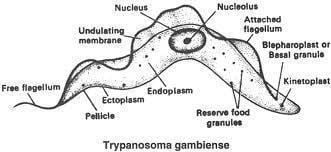

Adaptation to parasitic mode of life
Structural adaptations
- They have no contractile vacuole and no gullet as they are living in constant internal environment i.e. the blood.
- The undulating membrane increases surface area to volume ratio for absorption (no gullet). In some cases it is for locomotion in case of high viscosity.
- Being pointed at both ends, passage through the capillary is easier.
- There are small flagella as they are parasites and locomotion is limited.
Physiological adaptation
- The body fluids are isotonic to the blood plasma hence they do not need to regulate their mechanisms.
- Being parasites they require less thus have a few mitochondria for release of energy.
- Large surface area to volume ratio helps in excretion, nutrition and efficient gaseous exchange as all this is through diffusion.
Reproductive adaptation
- Binary fission occurs rapidly even under host high resistance mechanism.
- The spleen and the lung cells contain the resting forms of the parasite. Leishmania form of the parasite which can remain alive even when the parasites (slender form) in the general circulation are eliminated.
- The multiplication of the parasites up to infective stage in the tsetse fly serves as a good reservoir/storage.
Mwalimu
Unasoma somo hili? Niulize nikuelezee chochote kilichomo.
Ingia ili kumuuliza Mwalimu wa AI wa Sonza kuhusu mada hii.
Ingia ili kuulizaMajadiliano
Hakuna maswali bado
Inapakia majadiliano…