Mada za sehemu hiiGaseous Exchange And RespirationMada 4
The pyruvic acid formed as a result of glycolysis may, in the absence of oxygen, be converted to a variety of substances to yield a little energy. This is anaerobic pathways.
In the presence of oxygen, the pyruvic acid enters the Krebs cycle.
Before entering the actual cycle, one of the 3-carbon atoms of pyruvic acid is oxidized to CO₂ and a molecule of NAD is reduced by addition of two hydrogen atoms.
This leaves the acetyl group (CH₃CO) which is readily accepted by a coenzyme called coenzyme A.
The two-carbon acetyl group of this compound combines with a 4-carbon substance called oxaloacetic acid to give a six-carbon molecule, citric acid.
In a series of reactions, two carbon dioxide molecules are produced and 4-carbon oxaloacetic acid is regenerated in readiness to receive another 2-carbon acetyl group from acetyl coenzyme A. Other products include a total of eight hydrogen atoms which are used to reduce three molecules of NAD and one molecule of FAD.
These reduced electron carriers (NAD and FAD) eventually pass on the hydrogen atoms to oxygen, yielding 11 more ATP molecules for each pyruvic acid. In addition, a further ATP molecule is yielded directly during the cycle to give a total of 12 ATP per pyruvic acid molecule.
- It provides hydrogen atoms which ultimately yield the major part of the energy derived from the oxidation of glucose molecules. It is a valuable source of intermediates which are used to manufacture other substances, e.g., fatty acids, amino acids, and carotenoids.
This is the means by which the energy from the Krebs cycle in the form of hydrogen atoms is converted to ATP.
Much of the energy is in the form of hydrogen atoms which are attached to the hydrogen carriers NAD and FAD.
These atoms are passed along a series of carriers at progressively lower energy levels. As they lose their energy, it is harnessed to produce ATP molecules.
Therefore, for each molecule of NAD, three ATP, and two for each one of FAD.
The other carriers in the system are iron-containing proteins called cytochromes. The hydrogen splits into its protons and electrons during the pathway.
They combine with their proton before the final stage where the newly reformed hydrogen atoms combine with oxygen to form water.
It is very essential in aerobic respiration and only plays a role at this final stage. It is vital since it drives the process.
In the absence of oxygen, only anaerobic respiration continues. The transfer of hydrogen atoms is catalyzed by the enzyme cytochrome oxidase. This enzyme is inhibited by cyanide, thus preventing the removal of hydrogen atoms at the end of the respiratory chain. In these circumstances, the hydrogen atoms accumulate and aerobic respiration ceases, making cyanide a most effective respiratory inhibitor.
If no oxygen is available, the pyruvic acid formed at glycolysis does not enter the Krebs cycle but follows one of the anaerobic pathways, often referred to as fermentation.
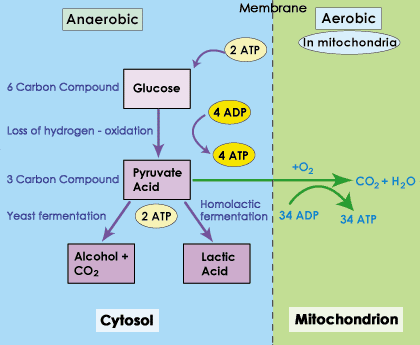
i. Acetaldehyde fermentation
ii. Alcoholic fermentation
iii. Lactic acid fermentation
This happens in higher animals, especially in muscles, when oxygen used exceeds supply.
- B1 – Thiamine: Involved in formation of some Krebs cycle enzymes. Forms a part of acetyl coenzyme A.
- B2 – Riboflavin: Forms part of hydrogen carrier flavoprotein (FP).
- B3 – Niacin (nicotinic acid): Forms part of coenzymes NAD and NADP. Forms part of acetyl coenzyme A.
- B5 – Pantothenic acid: Forms part of acetyl coenzyme A.
ATP is the form in which energy from the breakdown of glucose is temporarily stored.
When glucose is completely oxidized aerobically, the sources of ATP are:
- In glycolysis: This yields only 2 ATP.
- Krebs cycle: Also yields 2 ATP molecules.
- Respiratory chain: The number of ATP depends on the number of carrier molecules NADH₂ and FADH₂.
- (a) From glycolysis: 2 NADH₂
- (b) Conversion of pyruvate to acetyl CoA yields 2 NADH₂
- (c) From the Krebs cycle: 6 NADH₂ and 2 FADH₂ molecules.
Each pair of hydrogen atoms carried by NAD produces, in the respiratory chain as NADH₂, shunts its hydrogen to carrier 1. Where NAD occurs and each pair of hydrogen atoms carried by FAD shunts its hydrogen to carrier 2 where FAD occurs.
Thus 10 NADH₂ produce a total of 3 ATP × 10 NADH₂ = 30 ATP. 2 FADH₂ produce a total of 2 FADH₂ × 2 ATP = 4 ATP.
Thus when a molecule of glucose is completely oxidized aerobically, a total of 38 ATP molecules is synthesized.
| Stage | ATP produced directly | ATP produced indirectly | Total |
|---|---|---|---|
| Glycolysis | 2 ATP | 6 ATP | 8 ATP |
| Krebs cycle | 2 ATP | 22 ATP | 24 ATP |
| Pyruvate to acetate | — | 6 ATP | 6 ATP |
| Total | 4 ATP | 34 ATP | 38 ATP |
We have seen in the previous section that only glycolysis occurs during anaerobiosis and that the NADH + H⁺ it yields is not available for oxidative phosphorylation.
The total energy released is therefore restricted to the two ATP molecules formed directly.
In lactate fermentation, all is not lost, and the lactate may be converted to pyruvate by the liver and so enter the Krebs cycle, thus releasing the remaining energy.
Sugars are not the only materials which can be oxidized by cells to release energy. Both fats and proteins can, in certain circumstances, be used as respiratory substrates.
Respiration of fats
Fats are used as respiratory substrate when there is insufficient amount of carbohydrates. The oxidation of fats is preceded by its hydrolysis to glycerol and fatty acids.
Glycerol
Glycerol is phosphorylated by an inorganic phosphate to form glycerate phosphate (GP). Then oxidized by NAD to form dihydroxyacetone, which is then converted to its isomer, 3-phosphoglyceraldehyde (PGAL), and then fed into the glycolytic pathway at the point where PGAL occurs.
The NADH₂ is then passed to the respiratory chain with a total yield of 3 ATP molecules. The PGAL is passed to the glycolytic and Krebs cycle pathway with a total yield of 17 ATP molecules. Thus, the net gain of ATP when glycerol is aerobically oxidized is 20 − 3 = 17 ATP.
Fatty acids
Each fatty acid in the matrix of mitochondria undergoes oxidation in the process called β-oxidation. This involves the fragmentation of fatty acid to 2-carbon fragments. Each of these will be converted into acetyl CoA and then fed into the Krebs cycle at the point where acetyl CoA occurs.
The advantage of respiring fats is that fatty acids have a large number of hydrogen atoms which, when passed through the respiratory chain, yield a large amount of ATP molecules.
For example, the respiration of stearic acid, a fatty acid in animal adipose tissue, yields a total of 147 ATP molecules. The total number of ATP formed is 166 ATP from glyceride and fatty acids.
Protein is respired only when both carbohydrates and fats are totally absent, or when the need arises in the condition of starvation. When proteins are to be respired, first they are hydrolysed to amino acids, then deaminated.
Oxidative deamination
This process occurs in the liver cells and involves the removal of ammonia from an amino acid. This is by dehydrogenation and hydrolysis. Consider the deamination of glutaric acid:
Glutaric acid + NAD + H₂O → α-ketoglutaric acid + NADH₂ + NH₃
The ammonia is then excreted as either uric acid, urea, or pure NH₃, depending on the nature of the environment. The deaminated amino acid is converted into one of the Krebs cycle intermediates, depending on the number of carbon atoms. If it is a 5-carbon amino acid, it will be converted into α-ketoglutaric acid. If it is a 4-carbon amino acid, it will be converted into oxaloacetic acid. If it is a 3-carbon amino acid, it will be converted into pyruvic acid, later converted into acetyl CoA and fed into the Krebs cycle.
Transamination
This is a process whereby one amino group from one amino acid is transferred to a keto group of another amino acid so as to form a new amino acid. Hence, the conversion of one amino acid into another is controlled by the enzyme transaminase, and it can produce α-keto acids that directly enter the Krebs cycle.
Respiratory quotient (RQ) is a measure of the ratio of carbon dioxide evolved by an organism to that of oxygen consumed over a given period of time.
For example, the equation for a complete aerobic oxidation of hexose sugar is represented below:
However, it is difficult to have this theoretically calculated value, because a substrate is rarely completely oxidized.

- It helps to indicate the type of substrate oxidised; for example, the RQ value of 1.0 implies complete oxidation of glucose; RQ of 0.7 means oxidation of fats (fatty acids); and, for proteins, the RQ value varies, but it is around 0.9. The RQ values of less than one mean that oxidation of a mixture of substrates is taking place.
- It helps to indicate the type of metabolism taking place. For example, if RQ values are less than one, the following are possible:
- Aerobic oxidation, as the volume of carbon dioxide evolved is less than that of oxygen taken in.
The basal metabolic rate of an organism is the minimum rate of energy conversion required just to stay alive during rest or sleep. It is actually the amount of energy needed to maintain body functioning while at rest, to keep the heart beating, blood flowing, food digested, and body breathing.
It is also referred to as resting metabolic rate (RMR). In humans, BMR is measured after an individual has undergone a standardised rest period of between 12 to 18 hours of physical and mental relaxation without taking a meal during that period.
- Body size Small organisms have larger surface area to volume ratio, hence larger BMR than large organisms.
- Body composition Fat tissue has a lower metabolic activity than muscle tissue. As lean muscle mass increases, the metabolic rate increases.
- Sex The basal metabolic rate (BMR) of females is lower than that of males. On average, the BMR of females is 5 to 10 percent lower than that of males. The difference is that; generally, women possess more body fat and less muscle mass than men of similar size.
- Age The BMR decreases with age (aging). A decrease in lean muscle mass during adulthood results in a slow, steady decline in BMR.
- Climate and body temperature The BMR of people in tropical climates is generally up to 20 percent higher than their counterparts in more temperate climates because it takes energy to keep the body cool. Exercise performed in hot weather also imposes an additional metabolic load. Body fat content and effectiveness of clothing determine the magnitude of energy metabolism in cold environments; it takes energy to keep the body warm if you work or exercise in very cold weather.
- Hormonal levels Thyroxine (T₄) is the key hormone released by the thyroid glands which has a significant effect upon metabolic rate. Hypothyroidism is relatively common, especially in women near or after menopause. Everyone with a weight problem should have their thyroid function checked by their doctor and treated appropriately if it turns out to be low.
- Health status Fever, illness, or injury may increase resting metabolic rate. Therefore, a sick person has a higher rate of metabolism than a healthy person.
Mwalimu
Unasoma somo hili? Niulize nikuelezee chochote kilichomo.
Ingia ili kumuuliza Mwalimu wa AI wa Sonza kuhusu mada hii.
Ingia ili kuuliza