Mada za sehemu hiiForces That Affects The EarthMada 7
Weathering refers to processes whereby rocks disintegrate into small particles due to agents of weathering such as water, ice, wind, wave, etc. The process results from the forces of weather, such as changes in temperature, frost action, and rain action.
- Mechanical Weathering
- Chemical Weathering
- Biological Weathering
- This is also referred to as physical weathering. It is caused by changes in temperature and is common in areas with extreme temperature variations, such as hot deserts, arid, and semi-arid regions.
- Mechanical weathering includes the following types:
- Exfoliation: Occurs due to temperature change. During the daytime, rocks expand due to high temperatures and contract at night due to low temperatures.
- Granular Disintegration: The breaking up of rocks consisting of different minerals. These minerals expand and contract separately through temperature changes.
- Block Disintegration: Happens when a homogeneous rock breaks into rectangular blocks due to changes in temperature. This is common when the rock is jointed. This process can be aided by chemical weathering.
- Frost Action: Common in temperate regions where temperature falls to freezing point. When temperature falls, water collects in the rocks and freezes, its volume increases, causing cracks to deepen and widen.
- Involves the decomposition of some minerals in a rock when they come into contact with water (H₂O), oxygen (O₂), and carbon dioxide (CO₂), two of the gases in the air.
- Chemical weathering includes the following processes:
- Oxidation: Occurs when oxygen combines with a mineral, especially in rocks containing iron, forming iron oxides.
- Carbonation: Occurs when hydrogen carbonate ions react with a mineral to give a soluble compound, which can be carried away in solution. Hydrolysis often accompanies carbonation.
- Solution: Refers to the dissolution of a mineral with a chemical substance. Rainwater combines with atmospheric carbon dioxide and oxygen to form weak carbonic acid.
- Hydration: Some minerals absorb water and swell, causing internal stress and fracture of the rocks.
- Hydrolysis: Involves the reaction of hydrogen in water with certain mineral ions, resulting in chemical compounds that can be weathered through other processes.
- When plants grow on rocks, their roots penetrate rock joints, causing rocks to break apart. Human activities such as farming, mining, quarrying, and construction also contribute to rock disintegration.
- Macro- and microorganisms disintegrate rocks through burrowing and mineralization processes.
- Rock Composition: Some rocks weather quickly, while others do so slowly. For example, acidic rocks weather faster than basic rocks.
- Climate: Includes the effects of meteorological elements like moisture, temperature, wind, and air pressure.
- Topography and Vegetation: Topography affects weathering by exposing rocks to temperature, sun, and wind. Vegetation can protect rocks from weathering, while bare surfaces are more susceptible.
- Length of Exposure: The longer a rock is exposed to weathering agents, the greater the degree of alteration, dissolution, and physical breakup.
- Leads to soil formation as rocks disintegrate into soil.
- Weathering can shape rocks into attractive features, which can attract tourists and generate foreign exchange.
- Weakened rocks, due to weathering, are more easily acted upon by agents of erosion, shaping the earth and producing various landforms.
- Weathering influences human activities in an area.
- Weathered rocks are easier to exploit, e.g., in quarrying.
- Acts as a carbon sink, reducing the amount of carbon dioxide in the atmosphere.
Mass wasting is the movement of weathered materials downslope due to gravitational forces accompanied by rain action. It is also known as slope movement or mass movement.
- Slow Movement
- Rapid Movement
- The movement of soil at a very slow speed, with water acting as the lubricant.
- Slow mass wasting is categorized into several types:
- Soil Creep: The slow movement of soil downhill after water soaks it. This process is very slow, and evidence includes tilting of trees and the falling of buildings and fences.
Factors Influence Soil Creep:
- Alternate heating and cooling of the soil particles.
- The freezing of water in the soil causing frost heaving.
- Removal of the soil further down the slope.
- Percolation of water into the soil, acting as a lubricant.
- Ploughing of the soil, a fact that makes the soil loose and more mobile.
Talus Creep
- It takes place due to the processes of thawing and freezing and is more pronounced in high latitude regions.
- It is very common on the sides of mountains, scarps, and valleys.
- This is a very slow mass movement of screes.
Solifluction
- This is the slow movement or flowing of weathered materials, especially when mixed with water and gravels.
- It is limited to highlands and cold regions.

This involves the movement of materials in the form of mudflow, landslide, rock fall, and earth flow.
Earth Flow
- This type of movement occurs in humid regions.
- The materials on the earth's surface become so saturated with water that they gain weight and start to move down the slope under the influence of gravity.
Mudflow
- It is the movement of a large mass of unconsolidated rocks down the slope when saturated with water.
- It flows in a semi-liquid state.
- It is common in desert slopes, which are not protected by a cover of vegetation.
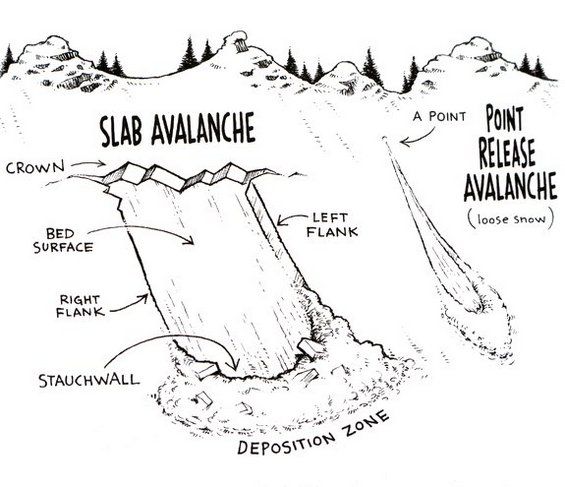
Avalanches
- It is a sudden and catastrophic movement of a wide variety of materials downslope associated with snow.
- The movement can take the form of flowing, sliding, or falling.
Landslide
- This is the rapid movement of surface rocks and soil down a steep slope, such as a cliff face.
- It includes slumping and sliding of materials.
Rock Fall
- This is the free-falling of a single mass of rock.
- It is common on steep slopes of mountains and along scarp slopes of the sea.

- Gradient or slope: When the gravitational force acting on a slope exceeds its resisting force, slope failure (mass wasting) occurs.
- Weathering: weathering processes weaken and loosen the rock, hence accelerating the process of mass wasting.
- Amount of water present in the rocks: Water can increase or decrease the stability of a slope depending on the amount present. Small amounts of water can strengthen soils because the surface tension of water increases soil cohesion.
- Vegetation: The roots of plants help bind the soil particles together making the soil resistant to agents of erosion and weathering.
- The nature or type of the rock materials: Clay soil is compact and resistant to various types of soil erosion agents and mass wasting as compared to sandy soil, which is normally loose and easy to remove and transport by water, gravity, wind, etc.
- Overloading: When the soil accumulates in one location as a heavy mass of the rock material, it can be moved either by action of gravitational force or application of just a little force
- Earthquakes: Earthquakes cause sections of the mountains and hills to break off and slide down. Earthquake tremors tend to loosen the soil material and make it easy to be removed and transported.
- Human activities: The activities of man such as cultivation, burning, mining, transportation, animal grazing, etc, removes the soil cover or leads to shaking of the soil.
- Climate: Climate has a great influence on mass wasting. Areas that receive heavy rains often experience mass movements, such as landslides and soil creep, more often compared to dry areas.
- Volcanicity: Volcanic activity often causes huge mudflows when the icy cover of a volcano melts and mixes with the soil to form mud as the magma in the volcano stirs preceding an eruption.
- Formation of scars and bare land: When a large mass of soil moves, such as it occurs in landslide, the process leaves behind a large portion of eroded, bare and unproductive land.
- Soil erosion: When mass movement takes place, the load often removes almost all the vegetation on its way. This exposes the land to agents of erosion such as wind, animals, water, ice, waves, etc.
- Formation of new landforms: The materials removed and transported to a distant location may form hills at their destination and form scars and depressions at the place of origin.
- Formation of lakes: Materials of landslide can block arriver bed and valley, preventing downward movement of water. The blocked water accumulates on the upper side of a river
- Diversion of a river course: The landslide material can block the natural river bed, forcing the river to divert and form a new route. This makes the river leave its usual flowing course, and form a new course.
- Formation of a fertile soil: If the removed material comes from a fertile land, it can form a fertile soil at the place of destination, where fertile soil never existed, and encourage agricultural activities to take place.
- Damage to property: Different categories of landslides may cause various damages to property and can adversely affect other resources. The effects of landslide are dangerous because they destroy everything in their path.
- Loss of life: The more populations expand and occupy more and more of the land surface, mass movement processes become more likely to affect humans
Mwalimu
Unasoma somo hili? Niulize nikuelezee chochote kilichomo.
Ingia ili kumuuliza Mwalimu wa AI wa Sonza kuhusu mada hii.
Ingia ili kuuliza