Mada za sehemu hiiForces That Affects The EarthMada 7
- External Forces and Internal forces
- Earth Movements
- Vulcanicity
- Earth-quakes
- Weathering
- Erosion and Deposition by Running Water, Ice, Wind and Wave Action
- Artificial Forces

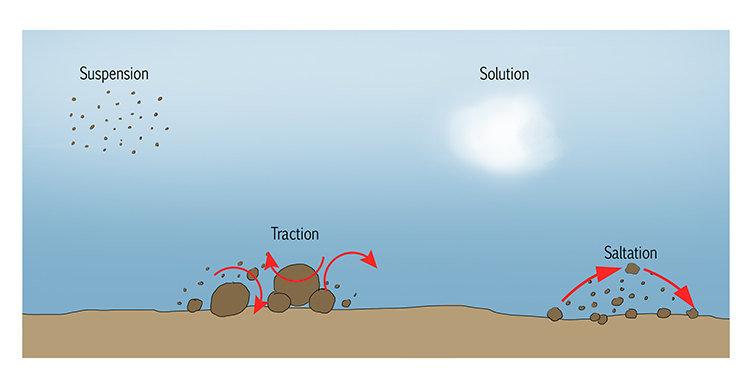
- River transport involves carrying away weathered and eroded materials from one place to another. The materials carried by the river are called the load.
- River transports its load in four ways:
- Saltation: Small pieces of rock fragments are carried by the river while bouncing on the riverbed.
- Traction: Large boulders, such as pebbles, are dragged or rolled along the riverbed.
- Suspension: Fine or light materials like silt and mud are carried in suspension. This occurs when the river flow is strong.
- Solution: Materials that dissolve in water are carried in solution form.
The first stage of a river, often referred to as the youth or torrent course.
Characteristics of the upper course:
- It is the source of the river.
- The speed of the river is high.
- Most of the work done by the river involves vertical erosion.
- The cross-section of the river valley is V-shaped.
- The slope of the profile is very steep.
- It is sometimes used for hydroelectric power (H.E.P) generation.
Erosional and depositional features:
The main features in the upper course are:
- Deep and narrow V-shaped valley
- Steep gradient
- Potholes on the riverbed
- Interlocking spurs
- Waterfalls and rapids, often with plunge pools
V-shaped valley
- A deep, narrow valley found in the youth or first stage of a river.
- Formed primarily through vertical erosion.
- The valley has a V shape due to the intense downcutting of the river into the bedrock.
- The sides of the valley are often steep and can be prone to erosion.
- Common in the upper course of a river, where water velocity is high and erosion is more pronounced.

Potholes
- These are circular depressions on the riverbed.
- They are formed when pebbles carried by the swirling water cut circular depressions in the river's bed.

Interlocking spurs
- An interlocking spur, also known as an overlapping spur, is one of any number of projecting ridges.
- These ridges extend alternately from the opposite sides of the wall of a young, V-shaped valley.
- A river with a winding course flows down these valleys.
Waterfall
- A waterfall is a place where water flows over a vertical drop in the course of a stream or river.

Rapids
- These are sections of a river where the riverbed has a relatively steep gradient.
- The steep gradient causes an increase in water velocity and turbulence.

Plunge pool
- This is a large depression formed at the base of a waterfall.
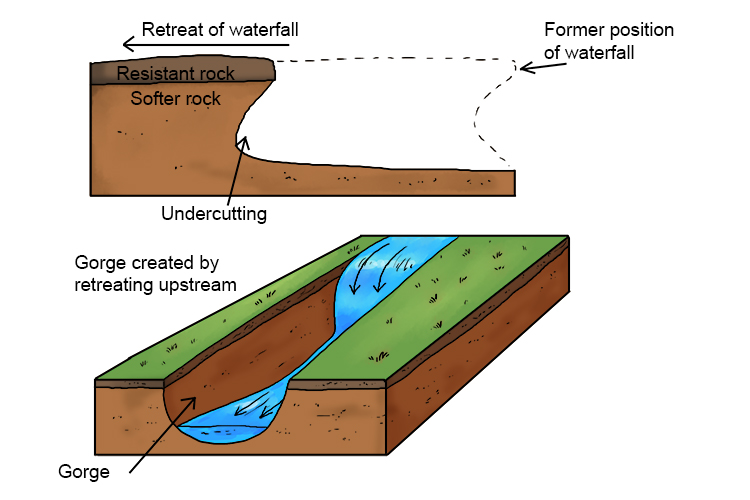
Gorge
- It is a steep, narrow, and elongated valley.
- A gorge is often formed when a waterfall retreats upstream (e.g., a gorge found in Victoria Falls).
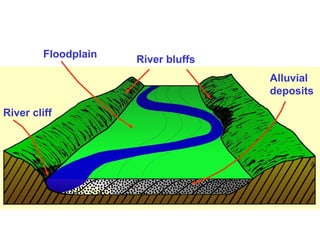
- This is the second stage of a river.
- The main features of this section are bluffs, waterfalls, and rapids.
The characteristic features of the middle course of a river valley:
The speed of a river is low.
- Most of the work of a river is transportation.
- The cross-section of a valley in this section is open.
- The slope of the relief is gentle.
- The volume of the river increases.
- Lateral erosion predominates.
Features associated with the middle course of a river valley:
- Bluffs: These are steep slopes of the truncated spurs in the middle course where interlocking spurs turn into bluffs.
Waterfalls and rapids:
- Waterfalls and rapids can also be found in the middle stage of the river valley.
- This is mainly caused by river rejuvenation, which increases erosive activity and transportation, hence the development of waterfalls.
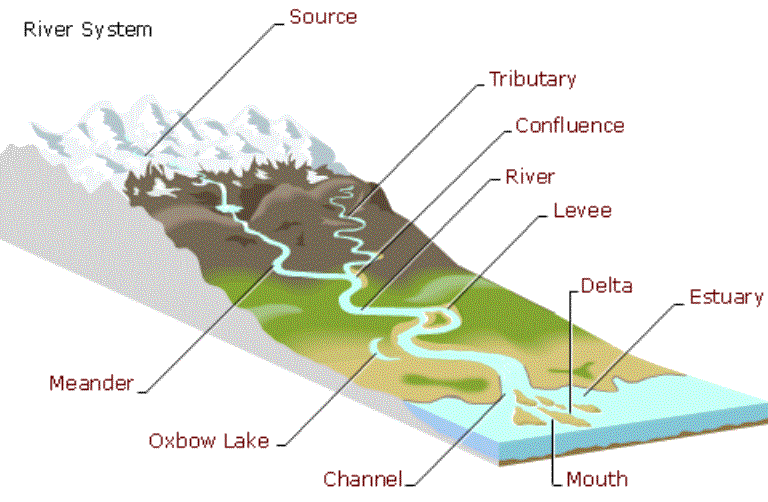
- This is the third stage of a river.
- The main features of the lower section of a river valley are:
- Flood plain
- Braided river
- Ox-bow lake
- Levee and deferred tributary
- Delta
Characteristics of lower stage
It is the river mouth.
- Always there are gradient falls or slope falls.
- The main work of a river is deposition.
- The cross section of a valley is a U-shaped valley.
- The speed of a river is decreased.
- The river valley is very wide.
Mwalimu
Unasoma somo hili? Niulize nikuelezee chochote kilichomo.
Ingia ili kumuuliza Mwalimu wa AI wa Sonza kuhusu mada hii.
Ingia ili kuulizaMajadiliano
Hakuna maswali bado
Inapakia majadiliano…