Mada za sehemu hiiStructure Of The EarthMada 3
- The Earth’s Crust, The Mantle, The Core and their Respective Characteristics
- Types of Rocks of the Earth’s Crust
- Simplified Geological Time Scale
The inner zones of the earth constitute the internal structure of the earth. The internal structure of the earth consists of three zones:
- Crust / Lithosphere
- Mantle / Mesosphere
- Core / Barysphere

Crust
-
The outermost and thinnest zone of the earth, found between 8–50 km (or 5–30 miles).
-
Also known as the Lithosphere.
-
Largely composed of igneous rocks (crystalline, hard, and brittle).
-
Consists of two layers:
- Sial:
- Outer layer of the crust.
- Rich in silica and aluminum minerals.
- Forms the basis of the continent.
- Sima:
- Found beneath the sial layer.
- Separated from sial by the Conrad discontinuity line.
- Composed of silica and magnesium.
- Sial:
Mantle
-
Also known as the Mesosphere.
-
Found between the crust and the core.
-
Separated from the crust by the Mohorovic discontinuity (Moho).
-
Extends downward to about 2900 km (1800 miles).
-
Temperatures may reach about 5000°C.
-
Consists of two parts:
- Upper Mantle:
- Rigid and together with the crust forms the lithosphere.
- Lower Mantle:
- Less rigid.
- Forms the asthenosphere (molten layer within the Earth's interior).
- Upper Mantle:
Core
-
The innermost zone of the Earth's structure.
-
Also known as the Barysphere or Centrosphere.
-
Diameter of about 6900 km (4300 miles).
-
High density.
-
Divided into two parts, separated from the mantle by the Gutenberg discontinuity:
- Outer Core:
- Liquid in nature due to high temperature (up to 3700°C).
- Composed of nickel and iron (NIFE).
- Thickness of about 2100 km.
- Density of about 10.5 g/cm³.
- Inner Core:
- Solid due to extremely high pressure.
- Composed mainly of iron.
- Diameter of about 2600–2700 km (1600–1700 miles).
- Outer Core:
Consists of four main layers:
- Atmosphere
- Hydrosphere
- Lithosphere (Landmass)
- Biosphere
Atmosphere
-
A thin layer of gases held around the earth by gravitational attraction.
-
Composed of:
- Abiotic components (non-living matter):
- Mixture of gases (Nitrogen, Oxygen, Argon, Carbon dioxide).
- Water vapor.
- Dust particles.
- Biotic components (living organisms):
- Microscopic organisms like bacteria.
- Abiotic components (non-living matter):
Composition of the atmosphere
- Mixture of gases:
- Nitrogen (78%)
- Oxygen (21%)
- Argon (0.009%)
- Carbon dioxide (0.03%)
- Water vapor:
- Colorless, odorless, and forms a perfect mixture with gases.
- Biota components:
- Includes microscopic organisms like bacteria.
Structure of the atmosphere
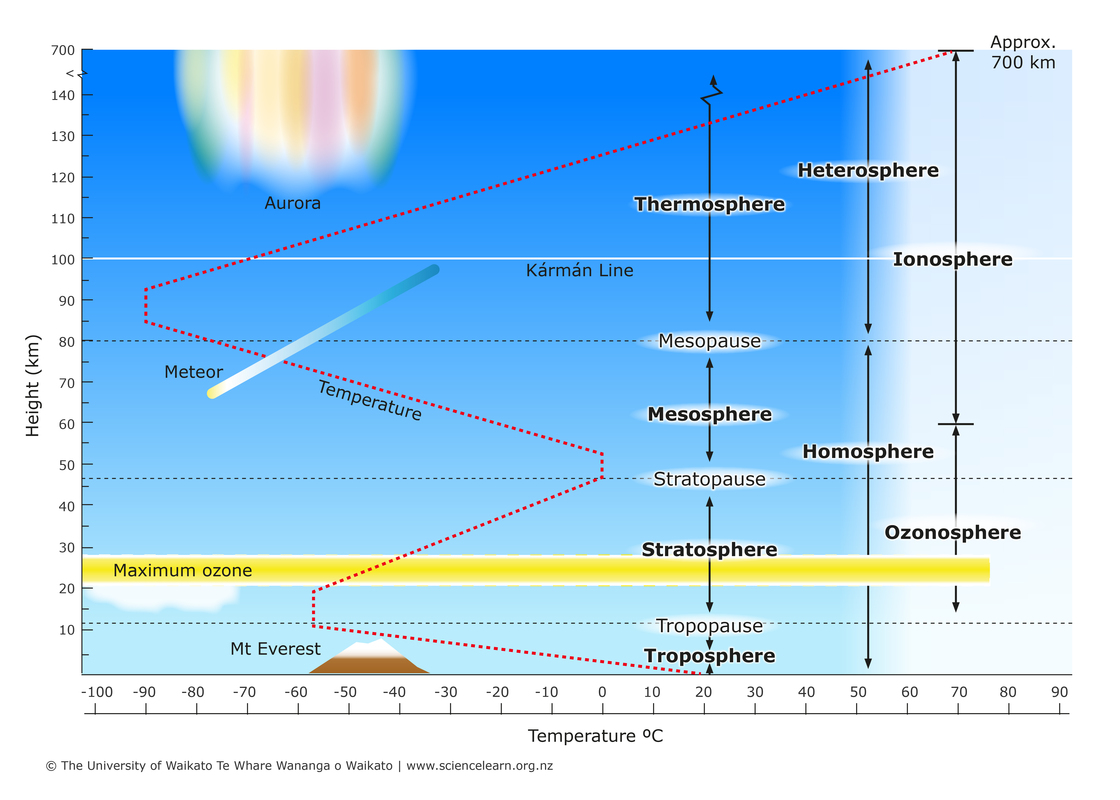
Divided into two zones based on temperature changes:
- Homosphere
- Heterosphere
Homosphere (0–80 km above sea level)
-
Composed of uniform gases and temperature.
-
Divided into three layers:
- Troposphere:
- Extends from 0–15 km.
- Nearest to Earth.
- Contains water vapor, gases, and dust.
- Supports life (plenty of oxygen).
- Stratosphere:
- Extends from 15–48 km.
- Lies above the tropopause.
- Contains water vapor, dust particles, and gases.
- High concentration of ozone gas.
- Mesosphere:
- Extends from 48–80 km.
- Temperature decreases with altitude.
- Separated from stratosphere by stratopause.
- Upper boundary is called mesopause.
- Troposphere:
Heterosphere (Above 80 km towards space)
-
Extends into interplanetary space.
-
Divided into two layers:
- Thermosphere:
- Temperature increases with altitude.
- Lacks water vapor and dust.
- Contains ions (affect radio communication).
- Exosphere:
- Found above the thermosphere.
- Very high temperatures but little research conducted.
- Thermosphere:
- Insulation:
- Acts as an insulator or shield, regulating temperature during the night and winter.
- Solar Filtering:
- Filters solar radiation.
- Prevents harmful ultraviolet (UV) rays of certain wavelengths from reaching the Earth's surface due to the ozone layer in the stratosphere.
- Scientific Function:
- Acts as a medium for scientific experiments and observations.
- Example: The ionosphere reflects some electromagnetic waves and radio signals back to Earth.
- Support for the Hydrological Cycle:
- Facilitates processes such as surface water evaporation, condensation, and precipitation formation.
- Support for Life:
- Provides essential gases like oxygen necessary for living organisms.
- Atmospheric pressure, due to the weight of air, enables breathing.
- Variations in atmospheric pressure cause wind movement and influence temperature, humidity, and precipitation.
- Refers to the layer consisting of all water bodies on Earth.
- Includes oceans, rivers, precipitation, and underground water.
- Covers approximately 75% of the Earth's surface.
- The solid part of the Earth.
- Includes various landforms such as mountains, valleys, and plateaus.
- Also known as the crust.
- Composed of:
- Continents (major land masses)
- Islands (minor land masses)
- A complex zone that includes all living things.
- Encompasses parts of:
- The lower atmosphere,
- The upper lithosphere,
- And the upper hydrosphere.
- Receives energy from the sun, providing conditions necessary for life.
- Unique to Earth, not found elsewhere in the solar system.
- Composed of elements, minerals, and rocks.
- These materials vary in physical and chemical properties.
Elements
- Smallest particles of matter that cannot be split into other forms.
- Examples include:
- Magnesium
- Potassium
- Sodium
- Iron
- Aluminum
- Silicon
Minerals
- Naturally occurring substances.
- Have definite shape, color, and resistance.
- Formed through the combination of different elements.
Mwalimu
Unasoma somo hili? Niulize nikuelezee chochote kilichomo.
Ingia ili kumuuliza Mwalimu wa AI wa Sonza kuhusu mada hii.
Ingia ili kuuliza