Mada za sehemu hiiGeneticsMada 7
RNA is a single-stranded polynucleotide. There are four types of nitrogenous bases in the structure of RNA, which are adenine (A), guanine (G), cytosine (C) and uracil (U).
The nitrogenous base is attached to carbon 1, while the phosphate group is attached to carbon 5. Hydroxyl groups are attached to carbon 2 and 3. The phosphate group of the next nucleotide in the sequence is linked to the hydroxyl group on carbon 3 of the preceeding nucleotide. This arrangement repeats itself several times to make RNA a long structure. It has to be noted that, the positioning of the hydroxyl group in carbon 2 of the sugar gives the molecule an electrostatic negative charge. It is because of this charge that, the (-OH) group repels negatively with the negatively charged phosphate group attached to the carbon 1 of the ribose sugar. This chemical structure makes RNA a long uncoiled molecule.
Diagram to show structure of RNA:

Messenger RNA carries the genetic code from DNA in the nucleus to the ribosome in the cytoplasm. This genetic code contains the information about the types of amino acids that should be joined together to form a protein molecule.

Ribosomal RNA (rRNA)
Ribosomal RNA (rRNA) or soluble RNA constitutes about 80% of the total RNA in the cell.
Ribosomal RNA is synthesized by a special DNA found in the nucleolus at a special region called a nucleolar organizer. It makes a bulk of the ribosome
- It is an integral part of the ribosome i.e. large proportion of the ribosome is made up on rRNA.
- It attracts other types of RNA i.e. mRNA and tRNA towards the ribosome during protein synthesis.
- Building Ribosomes: rRNA is a main part of ribosomes, which are the machines in the cell that make proteins. It helps form the large and small parts of the ribosome.
- Helping Chemical Reactions: rRNA acts like an enzyme. It helps join amino acids together to form a chain, which becomes a protein.
- Holding mRNA and tRNA in Place: rRNA helps to hold the mRNA (the message from DNA) and tRNA (the carrier of amino acids) in the right spots so they can work together to make proteins.
- Making Sure Everything Matches: rRNA helps to ensure that the codons (three-letter codes on mRNA) match correctly with the anticodons (codes on tRNA). This prevents mistakes in making proteins.
- Starting Protein Production: rRNA helps the ribosome attach to the mRNA at the right place to start making a protein.
- Keeping Ribosomes Stable: rRNA helps keep the ribosome parts together so they don't fall apart during the process of making proteins.

Transfer RNA (tRNA)
- This constitutes about 15% of the total RNA in the cell.
- Structurally, tRNA is a clover - lead shaped molecule with a folded loop - like chain.
- The looping of the chain, results into pairing of the folded of organic bases. Hence the formation of hydrogen bonds.
- The molecule has got four active / recognition sites.
- The upper site recognizes an amino acid, whereas the lower side (Anticodon) recognizes the mRNA. One of the sides recognizes the ribosome whereas the other one recognizes in enzymes, amino - acyl tRNA synthetase.
The role of tRNA is to carry the activated amino acids from various parts of the cytoplasm to their binding site, the ribosome.
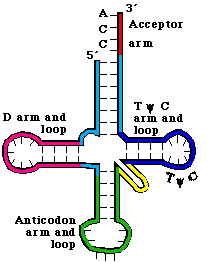
Structure of transfer RNA
Mwalimu
Unasoma somo hili? Niulize nikuelezee chochote kilichomo.
Ingia ili kumuuliza Mwalimu wa AI wa Sonza kuhusu mada hii.
Ingia ili kuulizaMajadiliano
Hakuna maswali bado