Mada za sehemu hiiAromatic HydrocarbonsMada 3
- Sources of Hydrocarbons
- Properties of Aromatic Hydrocarbons
- Substituted Benzene
Properties of aromatic hydrocarbons
Aromatic hydrocarbons are a class of compounds that contain one or more benzene rings in their structure. These compounds have distinct chemical and physical properties that set them apart from alkanes and alkenes. Below are the key properties of aromatic hydrocarbons.
Physical properties
- State: Aromatic hydrocarbons are typically colorless, volatile liquids or solids at room temperature. For example, benzene and toluene are liquids, while naphthalene is a solid.
- Boiling and melting points: Aromatic hydrocarbons generally have higher boiling points than alkanes of similar molecular weight due to the presence of the benzene ring. For example, benzene boils at 80.1°C, while toluene boils at 110.6°C. The melting points also vary with the size of the molecule and the presence of substituents on the benzene ring.
- Density: Aromatic hydrocarbons are less dense than water, and most of them float on water. For instance, the density of benzene is about 0.879 g/cm³, which is lower than that of water (1 g/cm³).
- Solubility: Aromatic hydrocarbons are non-polar compounds and are therefore insoluble in water but soluble in organic solvents such as alcohols, ethers, and chloroform. For example, benzene and toluene are soluble in alcohol and ether.
- Odor: Aromatic hydrocarbons typically have a distinct sweet or pleasant odor. Benzene, toluene, and xylene all have noticeable smells, which can be aromatic and aromatic hydrocarbons can contribute to air pollution.
Chemical properties of aromatic hydrocarbons
Aromatic hydrocarbons, such as benzene, undergo a variety of chemical reactions, which are mostly characterized by the Electrophilic Aromatic Substitution (EAS) mechanism. Below are the chemical properties with vivid reactions:
Electrophilic aromatic substitution (EAS)
This is the most common type of reaction in aromatic hydrocarbons. In EAS, an electrophile (a positively charged species) replaces a hydrogen atom on the benzene ring. Some key EAS reactions are:
Bromination
Benzene reacts with bromine (Br₂) in the presence of a Lewis acid catalyst, like ferric bromide (FeBr₃), to form bromobenzene.
 + Br₂ →
  + HBr
+ HBr
Nitration
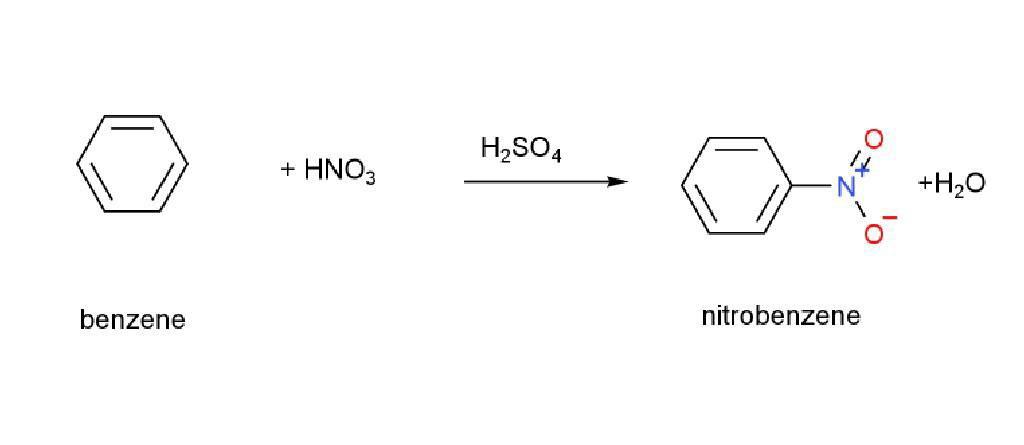
Benzene reacts with a mixture of concentrated nitric acid (HNO₃) and sulfuric acid (H₂SO₄) to form nitrobenzene.
C₆H₆ + HNO₃ → C₆H₅NO₂ + H₂O
Friedel–Crafts alkylation
In this reaction, an alkyl halide (R–Cl) reacts with benzene in the presence of an AlCl₃ catalyst to form an alkylated aromatic compound.
C₆H₆ + R–Cl → C₆H₅R + HCl
Friedel–Crafts acylation
In this reaction, an acyl chloride (RCO–Cl) reacts with benzene in the presence of AlCl₃ to form acetophenone.
C₆H₆ + RCOCl → C₆H₅CO–R + HCl

Hydrogenation (reduction)
Aromatic hydrocarbons can be hydrogenated (reduced) to form cycloalkanes. This reaction typically occurs under high pressure and in the presence of a catalyst such as nickel (Ni) or platinum (Pt).
Hydrogenation of benzene
C₆H₆ + 3H₂ → C₆H₁₂
Benzene is reduced to cyclohexane under these conditions.
Oxidation
Aromatic hydrocarbons are generally resistant to oxidation. However, they can be oxidized by strong oxidizing agents such as potassium permanganate (KMnO₄) or chromium-based compounds (e.g., K₂Cr₂O₇). The oxidation products depend on the structure of the starting aromatic compound.
Oxidation of benzene to carboxylic acids
When benzene is oxidized with KMnO₄ under heat, it is converted into benzoic acid (C₆H₅COOH).
C₆H₆ + 2KMnO₄ + 2H₂O → 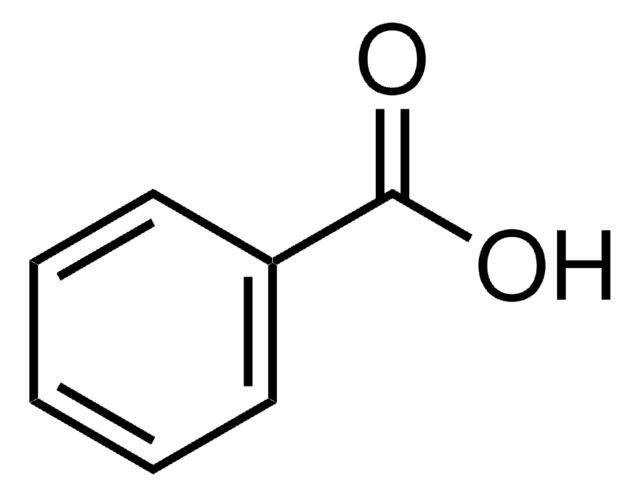 + 2MnO₂ + K₂CO₃
Oxidation to phenols
With milder oxidation conditions, benzene can be oxidized to form phenol (C₆H₅OH).
C₆H₆ + O₂ → 
Reaction with halogens (halogenation)
Aromatic hydrocarbons like benzene undergo halogenation, where a halogen (X₂, such as Cl₂ or Br₂) replaces a hydrogen atom on the benzene ring. A catalyst such as iron (Fe) or aluminum chloride (AlCl₃) is usually required.
Chlorination of benzene
C₆H₆ + Cl₂ →  + HCl
+ HCl
Ozonolysis of alkenes (for aromatic hydrocarbons with double bonds)
Ozonolysis is a reaction where ozone (O₃) cleaves the carbon-carbon double bond in alkenes or aromatic compounds with unsaturated bonds. This reaction can be used to locate the position of double bonds in the compound.
Ozonolysis of styrene
Styrene undergoes ozonolysis to give aldehydes or ketones as products.
C₆H₅CH=CH₂ + O₃ →  + CH₂O
Electrophilic addition of hydrogen halides
Alkyl-substituted aromatic hydrocarbons like toluene undergo electrophilic addition with hydrogen halides (HX, such as HCl or HBr). This reaction follows Markovnikov's Rule, where the hydrogen adds to the carbon with the most hydrogen atoms already attached.
Addition of HCl to toluene
C₆H₅CH₃ + HCl → C₆H₅CH₂Cl
Formation of phenols from aromatic hydrocarbons
Aromatic hydrocarbons, like benzene, can be converted to phenols via oxidation reactions. One example involves the hydroxylation of benzene using hydroxyl radicals (OH•) under appropriate conditions.
Hydroxylation of benzene
C₆H₆ + OH• → C₆H₅OH
Nucleophilic substitution reactions (in alkyl-aromatic compounds)
In some alkylated aromatic compounds, nucleophilic substitution reactions can occur. A common example is the substitution of an alkyl group (R) by a halogen (Cl) in a benzyl chloride reaction.
Nucleophilic substitution in benzyl chloride
C₆H₅CH₂Cl + NaOH → C₆H₅CH₂OH + NaCl
Toxicity and environmental impact
- Toxicity: Many aromatic hydrocarbons are toxic and carcinogenic. Benzene, for example, is a well-known carcinogen, and exposure to it can lead to various health problems, including leukemia. Long-term exposure to other aromatic compounds like toluene and xylene can cause neurological and liver damage.
- Environmental impact: Aromatic hydrocarbons contribute to environmental pollution when released into the atmosphere through industrial emissions, vehicle exhaust, or the use of petroleum-based products. They are persistent in the environment and can accumulate in ecosystems, posing a threat to wildlife and human health.
Industrial uses of aromatic hydrocarbons
- Solvents: Aromatic hydrocarbons like toluene, xylene, and benzene are widely used as solvents in industrial applications such as paint thinners, cleaning agents, adhesives, and varnishes.
- Synthesis of chemicals: Aromatic hydrocarbons are important intermediates in the synthesis of various chemicals like phenol, styrene, and nylon. Benzene, for instance, is used in the production of styrene (used in making polystyrene plastics).
- Pharmaceutical industry: Aromatic hydrocarbons are used as starting materials for the production of pharmaceuticals. For instance, toluene is used in the synthesis of several pharmaceutical products.
- Polymer production: Aromatic compounds like styrene are used as monomers in the production of synthetic polymers like polystyrene and other plastics.
Mwalimu
Unasoma somo hili? Niulize nikuelezee chochote kilichomo.
Ingia ili kumuuliza Mwalimu wa AI wa Sonza kuhusu mada hii.
Ingia ili kuulizaMajadiliano
Hakuna maswali bado