Mada za sehemu hiiGrowth And DevelopmentMada 5
- Mitosis
- Growth Patterns
- Growth and Development in Plants
- Primary and secondary growth in Angiosperms
- Seed dormancy and viability
Primary and secondary growth in angiosperms
Primary growth
Primary growth is the initial form of growth in plants, driven by the activity of apical meristems located at the tips of roots and shoots. This growth is characterized by the elongation of plant organs and the formation of the primary plant body. It is the sole form of growth in monocotyledonous and herbaceous dicotyledonous plants.
Zones of primary growth
- Zone of cell division: Apical meristem cells divide mitotically to produce many daughter cells.
- Zone of elongation: Newly formed cells elongate due to vacuolar expansion and turgor pressure, contributing to organ elongation.
- Zone of maturation: Cells fully mature, with vacuoles occupying up to 90% of the cell volume, and secondary thickening occurs in the cell walls.
Meristematic areas in the shoot
- Protoderm: Forms the epidermis (protective outer layer).
- Ground meristem: Gives rise to ground tissues like parenchyma and cortex.
- Procambium: Develops vascular tissues such as xylem, phloem, and cambium.
Primary growth of the shoot
Primary growth in the shoot apex occurs as a result of mitotic division in the shoot apical meristem cells. This process leads to the formation of three primary meristematic tissues that differentiate into specific parts of the plant.
Meristematic tissues and their functions
- Protoderm: Differentiates into the epidermis, which forms the protective outer layer of the plant shoot.
- Procambium: Develops into vascular tissues, including:
- Xylem: Responsible for water and mineral transport.
- Phloem: Facilitates transport of organic nutrients.
- Cambium: A meristematic tissue that contributes to further vascular development.
- Ground meristem:
- Produces ground tissues, such as:
- Cortex: Supports the stem and stores nutrients.
- Pith: Occupies the central region of the stem and stores nutrients.
- Produces ground tissues, such as:
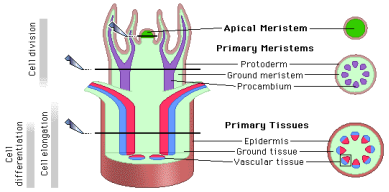
Stages of primary growth in shoots
- Cell division: Occurs in the apical meristem to produce a large number of daughter cells.
- Cell elongation: Newly formed cells elongate due to vacuolar expansion, contributing to the extension of the shoot.
- Cell differentiation: Cells specialize into different tissue types (epidermis, vascular tissues, and ground tissues).
Development of leaf primordia
- Small outgrowths called leaf primordia form on the shoot apex.
- These develop into leaves, contributing to photosynthesis and further plant growth.
The process of primary growth in the shoot ensures elongation and the formation of the primary plant body, which supports leaves, buds, and flowers.
Primary growth in the root apex
The primary growth in the root apex is governed by the activities of meristematic cells located at the root tip. These cells divide and differentiate into specialized tissues, contributing to the elongation and development of the root.
Key structures in the root apex
-
Root cap: A mass of unorganized cells formed by outward cell division.
Functions:
- Protects the root apical meristem as the root grows through the soil.
- Acts as a gravity sensor, helping the root orient itself.
-
Quiescent zone: Located just behind the root cap. Contains cells that divide infrequently.
Functions:
- Serves as a reservoir for replacing damaged apical meristem cells.
- Plays a role in organizing patterns of primary growth.
-
Apical meristematic cells: Divide actively to produce three primary meristematic tissues:
- Protoderm: Develops into the epidermis.
- Ground meristem: Forms the cortex and other ground tissues.
- Procambium: Forms the central vascular cylinder (xylem, phloem, and pericycle).
Zones of growth in the root apex
- Zone of cell division:
- Extends 1–2 mm back from the root tip.
- Contains actively dividing meristematic cells.
- Zone of cell elongation:
- Extends about 10 mm behind the root tip.
- Cells elongate due to vacuolar expansion, pushing the root deeper into the soil.
- Zone of cell differentiation (maturation):
- Cells specialize into various tissues:
- Epidermis, cortex, endodermis, xylem, and phloem.
- Root hairs form in this zone, enhancing water and nutrient absorption.
- Cells specialize into various tissues:
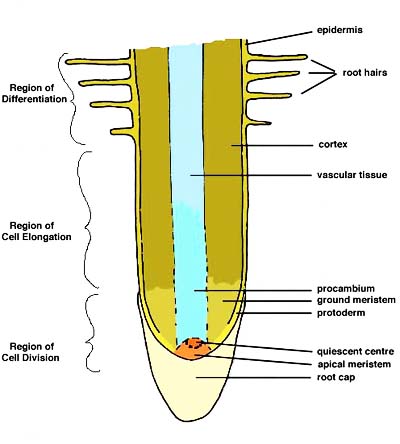
Vascular tissue differentiation in the root
Xylem and phloem:
- Development begins in the zone of cell division and continues in the zone of elongation.
- Xylem and phloem differentiation follows an exarch development pattern:
- Xylem develops from the outside inwards.
- This contrasts with endarch development in stems, where xylem develops from the inside outwards.
This pattern of primary growth ensures that roots elongate effectively while developing specialized tissues for absorption, transport, and support.
Secondary growth
Secondary growth occurs in dicotyledonous plants and is characterized by an increase in plant girth or diameter. It involves the activity of lateral meristems:
- Vascular cambium: Adds secondary xylem (wood) and secondary phloem.
- Cork cambium: Produces cork cells, contributing to the protective bark.
This growth results in the formation of secondary vascular tissues and thickened stems or roots, allowing plants to sustain their structures as they grow taller and wider.
The role of lateral meristems in secondary growth
Lateral meristems are responsible for secondary growth in both stems and roots of woody plants. This type of growth leads to an increase in the plant's diameter or girth. It involves the activity of two types of lateral meristems: vascular cambium and cork cambium.
Types of lateral meristems
-
Vascular cambium: Located between the primary xylem and phloem. Divides mitotically to form:
- Secondary xylem (towards the inside).
- Secondary phloem (towards the outside).
Consists of:
- Fusiform initials: Produce secondary xylem and phloem.
- Ray initials: Form parenchyma cells that create medullary rays, which are involved in storage and lateral transport.
-
Cork cambium: Found in the pericycle region near the plant's outer surface.
- Produces:
- Phellem (cork): Forms a protective outer layer.
- Phelloderm: Forms part of the secondary cortex.
- Replaces ruptured epidermis as the plant's girth increases.
- Produces:
Secondary growth in woody dicotyledonous stems
Begins after primary cell differentiation is complete.
Key processes:
- The vascular cambium divides to produce:
- Large quantities of secondary xylem (wood) internally.
- Smaller quantities of secondary phloem externally.
- Deposition of lignin in secondary xylem strengthens the stem.
- Medullary rays, formed by ray initials, facilitate lateral transport and storage.
- Cork cambium develops to replace the ruptured epidermis.
Results in the formation of annual growth rings, visible in woody stems due to alternating layers of dense (late wood) and less dense (early wood) secondary xylem.

Secondary growth in dicotyledonous roots
Similar to secondary growth in stems.
- Processes:
- Vascular cambium produces secondary xylem and phloem.
- Cork cambium arises from the pericycle and replaces the ruptured epidermis with cork.
- Enlarging secondary tissues cause the cortex and epidermis to shed over time.

Origin of lateral branches and roots
- Lateral branching:
- Occurs through the growth of axillary buds derived from detached meristems.
- Growth is regulated by the hormone auxin, produced by the apical meristem.
- Lateral buds grow when apical dominance ceases, either naturally or due to the removal of the apical meristem.
- Lateral roots:
- Originate endogenously from the pericycle in the main root, near the xylem poles.
- Development involves contributions from both the pericycle and endodermis.
- In monocotyledons, lateral roots may form opposite protoxylem or phloem.
- Adventitious roots:
- Arise from non-root tissues, such as stems or leaves.
- Their origin may be endogenous (from inner tissues) or exogenous (from outer tissues like the epidermis).
Significance of secondary growth
- Provides mechanical support and structural stability to the plant.
- Increases the capacity for water and nutrient transport through additional vascular tissues.
- Forms protective layers, such as bark, which safeguard the plant from environmental stressors.
Key differences
| Aspect | Primary growth | Secondary growth |
|---|---|---|
| Location | Root and shoot apices | Lateral meristems |
| Function | Increases length | Increases girth/diameter |
| Tissues formed | Primary tissues | Secondary xylem and phloem |
| Plant types | Monocots and herbaceous dicots | Woody dicots and gymnosperms |
Mwalimu
Unasoma somo hili? Niulize nikuelezee chochote kilichomo.
Ingia ili kumuuliza Mwalimu wa AI wa Sonza kuhusu mada hii.
Ingia ili kuulizaMajadiliano
Hakuna maswali bado