Mada za sehemu hiiGrowth And DevelopmentMada 5
Patterns of Growth
Growth refers to an irreversible increase in size, mass, or complexity of an organism. It can occur in various patterns based on the rates of synthesis (anabolism) and breakdown (catabolism) of materials and the growth dynamics of specific organs.
Positive and Negative Growth
-
Positive Growth Positive growth occurs when anabolism (synthesis of materials) exceeds catabolism (breakdown of materials). Example**:** In plants, the production of seedlings involves an increase in:
-
-
- Cell number
- Cell size
- Fresh mass
- Length
- Volume
- Complexity of form As the seedling begins photosynthesizing, it synthesizes its own food, promoting growth.
-
-
Negative Growth Negative growth occurs when catabolism exceeds anabolism, leading to a net loss in mass. Example: In germinating seeds, there may be an increase in dry mass, as stored food is broken down for energy during germination.
Allometric and Isometric Growth
Allometric Growth
Allometric growth refers to the unequal growth of different parts of an organism, resulting in changes in shape as the organism develops.
This pattern is typical in animals.
Different organs grow at varying rates, producing characteristic shapes and sizes.
Examples:
In humans, organs such as the heart, brain, and gonads (reproductive organs) have different growth rates.
In animals, the reproductive organs are often the last to develop and differentiate.
 Isometric Growth
Isometric growth occurs when all parts of an organism grow at the same rate, maintaining the same proportions.
This type of growth is less common and typically seen in simpler organisms or specific developmental stages.
Isometric Growth
Isometric growth occurs when all parts of an organism grow at the same rate, maintaining the same proportions.
This type of growth is less common and typically seen in simpler organisms or specific developmental stages.

Limited Growth (Definite/Determinate Growth)
Definition: Limited growth refers to a type of growth that stops once the organism matures and reaches its reproductive age.
Growth ceases at a specific stage of development.
Typical in organisms with a defined life cycle.
Examples:
Annual Plants: These plants grow, mature, reproduce, and die within a single growing season.
Certain Animal Structures: For example, the growth of human bones and most animal organs stops after maturity.
Unlimited Growth (Indefinite Growth)
Unlimited growth refers to continuous growth that persists throughout the organism's lifetime. This type of growth is often associated with organisms or structures that can regenerate or keep producing new cells indefinitely. Growth often follows a sigmoid (S-shaped) curve, characterized by:
- Lag Phase: Slow initial growth
- Exponential Phase: Rapid growth
- Plateau Phase: Slowing down as resources become limiting or growth stabilizes.
Examples:
Perennial Plants: Trees and shrubs exhibit unlimited growth, as their stems, roots, and branches continue to grow year after year.
Certain Animal Structures: For example, nails, hair, and teeth in some animals grow continuously.
Measuring growth.
Growth can be measured using different parameters e.g. Length/ height, mass (dry/ fresh), weight, volume, area.
Growth curvesThese are graphs obtained when data obtained from different parameters of measuring growth are plotted against time.
The curves show the overall growth pattern and extent of growth. It has found that growth pattern in many organism tend to be the same regardless the parameter used in measuring growth. In many cases if there is increase in measurable parameter is plotted against time an S- shaped growth curve is obtained. The shape of these curves is described as sigmoid, meaning S- shaped. The term sigmoid is derived from the Greek word sigma meaning letter S. A sigmoid curve is divided into four (4) parts or phases.
- Lag phaseThis is the initial phase during which little growth occurs (slightly decrease in growth).In flowering plants this phase show a slight decrease in growth. This is the result of loss of dry mass during seed germination. In microorganism a few may die at the time of inoculation to the culture medium therefore showing decrease in number. Due to this phase the population of micro-organism can grow rather slowly because they may have been in dormant state and time is required before their metabolism begin to work efficiently. Other reason for little growth for micro-organism may be adjustment to the new diet.
- **The log phase or exponential phase.**This refers to the grand period of growth during which growth proceeds exponentially. During this phase the rate of growth is at maximum. The rate of growth is proportional to the amount material or number of cells or organism already present. In microscopic organisms this phase occurs when there is no limiting growth. Nutrients and oxygen are in plentiful supply ample space is available. In flowering plants is the period when green follicles increase in amount.
- Stationary phaseThis marks the period where the overall growth has ceased .The parameters under consideration remain constant In microorganisms it is the phase when the number in the culture stabilize besides they neither decrease nor increase i.e. the number of individual dying are approximately equal to the number of new individual formed.
- **Decelerating phase (decline phase)**This is the period in which growth become limited as the result of the effect of some internal and external factors, or the interaction of both. In many mammals including humans, this marks the period of negative growth. It is a period of senescence associated with increasing age. In microorganisms which are grown in a confined environment, this is the period where the carrying capacity of the environment declines and it is unable to support the high density of organisms. Nutrients are decreasing and excretory products are increased in the medium. The rate of growth keeps on decreasing until all organisms die as a result of starvation, shortage of oxygen or presence of waste products in toxic amount.
Growth Pattern of Arthropods
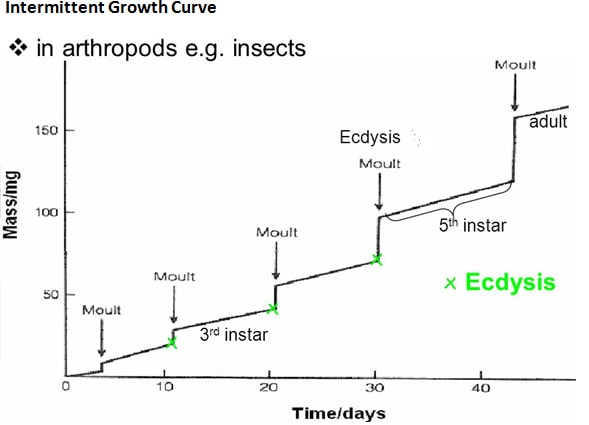
Arthropods, such as cockroaches, exhibit a unique type of limited growth known as discontinuous (intermittent) growth. This growth pattern occurs due to their hard, inelastic exoskeleton, which restricts continuous growth.
Key Characteristics of Arthropod Growth:
- Moulting (Ecdysis):
- Moulting is the periodic shedding of the exoskeleton in arthropods to allow for growth.
- It is necessary because the exoskeleton is rigid and does not expand as the organism grows.
- A new, larger exoskeleton is formed after moulting, enabling the arthropod to increase in size before the new exoskeleton hardens.
- **Hormonal Control:**Two hormones regulate the moulting process:
- Ecdysone (Moulting Hormone):
- Produced by the prothoracic gland in the first thoracic segment.
- Stimulates the moulting process by initiating the shedding of the exoskeleton.
- **Juvenile Hormone (Neotonin):**Produced by the corpus allatum, a gland located behind the brain.
Determines the type of moult:
- High concentration: Larval moult occurs, and the organism remains in the larval stage.
- Low concentration: Pupal moult occurs, transitioning the organism to the pupal stage.
- Absence: The organism metamorphoses into an adult (imago).
- Ecdysone (Moulting Hormone):
- Growth Curve:
- The growth of arthropods follows a step-like curve rather than a smooth, continuous curve.
- Each step corresponds to a moulting event, during which the size of the arthropod increases significantly.
- After moulting, there is a sharp increase in body size before the new exoskeleton hardens and limits further growth until the next moult.
Stages of Growth in Arthropods (e.g., Cockroach):
- **Instars:**Growth is divided into developmental stages called instars, each separated by a moulting event.
For example, in cockroaches:
- 1st instar → 2nd instar → 3rd instar → 4th instar → 5th instar → Adult
- The number of instars varies across species.
- MetamorphosisComplete metamorphosis includes larva → pupa → adult, while incomplete metamorphosis includes nymph → adult.
 Growth in insects.
The process of growth in insects involves changes in body for involving number of stages in their life cycle i.e. from the young to the adult form. The changes of forms from the young to the adults are referred to as metamorphosis**.**
Metamorphosis is found also in other groups of organisms such as amphibians, molluses, crustaceans, trematodes, cestodes and echinoderms to mention a few. In these organisms the term metamorphosis applies to those rapid changes which occur during the transition from larva to adult form.
Growth in insects.
The process of growth in insects involves changes in body for involving number of stages in their life cycle i.e. from the young to the adult form. The changes of forms from the young to the adults are referred to as metamorphosis**.**
Metamorphosis is found also in other groups of organisms such as amphibians, molluses, crustaceans, trematodes, cestodes and echinoderms to mention a few. In these organisms the term metamorphosis applies to those rapid changes which occur during the transition from larva to adult form.
Mwalimu
Unasoma somo hili? Niulize nikuelezee chochote kilichomo.
Ingia ili kumuuliza Mwalimu wa AI wa Sonza kuhusu mada hii.
Ingia ili kuulizaMajadiliano
Hakuna maswali bado