Mada za sehemu hiiEvolutionMada 5
- Theories of the Origin of Life.
- Theories of Organic Evolution.
- Evidence for Evolution.
- Selective Breeding
- Speciation
Jean-Baptiste Lamarck, a French biologist, proposed a theory in the early 19th century to explain how organisms evolve. His theory, known as Lamarckism, was based on two primary concepts:
- Use and Disuse of Organs Organisms can change during their lifetime based on how frequently they use certain body parts. The more an organ or structure is used, the stronger and more developed it becomes. Conversely, if an organ is not used, it can weaken and eventually disappear.
- Inheritance of Acquired Characteristics Traits that an organism acquires during its lifetime due to environmental pressures or usage of body parts can be passed down to offspring. In other words, changes to an organism's phenotype (observable traits) as a result of behavior or environmental factors are inherited by the next generation.
Lamarck used several examples to explain his theory:
Development of long neck and legs in giraffes
- Lamarck believed that the ancestors of giraffes had short necks and legs and lived on the plains, feeding on grasses. When the environment changed and grass became scarce, giraffes had to stretch their necks and legs to reach the leaves of tall trees.
- Over time, this constant stretching led to slightly longer necks and legs in each generation. These acquired traits (longer necks and legs) were passed on to future generations, leading to the modern giraffe with its long neck and legs.
Development of webbed feet in ducks
- According to Lamarck, ducks initially had feet adapted for walking on land. When food became scarce on land, ducks had to search for food in water. To swim more efficiently, ducks began stretching their toes, and the skin between the toes expanded to form webbed feet.
- These acquired traits (webbed feet) were passed down to subsequent generations, making webbed feet a characteristic of ducks and other aquatic birds.
Development of flat-shaped fish
- Lamarck believed that fish initially had various shapes suited for shallow waters. However, as food became scarce in shallow waters, fish moved to deeper waters. Over time, the fish's body shape changed, becoming flatter for more efficient swimming in deep waters.
- The acquired trait of a flat body shape was then inherited by subsequent generations of fish.
Strengths of Lamarck's theory
- Stimulated Scientific Inquiry Lamarck's work was one of the first to suggest that evolution occurs through changes in organisms' characteristics over time. His ideas led to more in-depth exploration and discussion about the mechanisms behind evolution.
- Recognition of the Role of the Environment Lamarck recognized that the environment plays an important role in shaping the traits of organisms. This idea was later confirmed in evolutionary biology, as environmental pressures often drive adaptations in species.
- Encouraged Critical Thinking His theory encouraged scientists to think critically about how life on Earth evolved, opening doors for further theories and research on evolution.
Weaknesses of Lamarck's theory
- Inheritance of Acquired Traits is Unsubstantiated Lamarck's idea that acquired characteristics are inherited was later proven wrong. Modern genetics shows that phenotypic changes (like increased muscle size due to exercise) are not passed down genetically because they do not affect the genotype (the genetic makeup). Therefore, traits gained during an organism's lifetime do not get inherited by offspring.
- Use and Disuse of Organs Does Not Cause Evolution The idea that using or not using a body part leads to its development or atrophy was not proven to be true. For example, Weismann's experiment in the late 19th century involved cutting off the tails of mice for several generations, expecting them to have shorter tails over time. However, the offspring continued to be born with tails of normal size, disproving Lamarck's theory.
- No Explanation of Mechanism for Change Lamarck didn't explain how acquired characteristics could influence the genetic code or how they were passed on to future generations, a concept that was later clarified with the discovery of genetics.
Charles Darwin developed his theory of evolution based on natural selection. During his voyage on the HMS Beagle (1831-1836), he observed variations among species and their adaptation to environments. He developed the theory of natural selection, which states that organisms with favorable traits are more likely to survive and reproduce, passing these traits to the next generation.
Key concepts in Darwin's theory
- Overproduction: Species tend to produce more offspring than the environment can support.
- Struggle for Existence: Competition for resources (food, shelter, mates) arises because of overproduction.
- Variation: Within every population, there are variations among individuals. These variations can be favorable (helping survival) or unfavorable.
- Natural Selection: Those with favorable traits (better adapted to the environment) survive and reproduce, while others perish. Over generations, this process leads to the evolution of species.
Darwin's observations and deductions
- Observation 1: More offspring are produced than can survive, leading to competition.
- Observation 2: Despite overproduction, population sizes tend to stay relatively constant.
- Deduction 1: There's a struggle for existence among individuals in a population.
- Observation 3: Variations exist among individuals, and the traits that help survival tend to be passed on.
- Deduction 2: Natural selection ensures that only the most adapted individuals survive and reproduce.
Types of natural selection
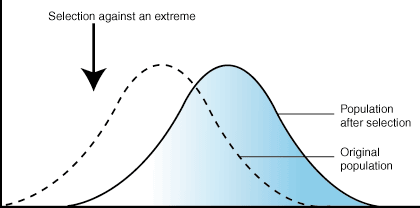
-
Directional Selection Favors one extreme of a trait. For example, long-necked giraffes had a better chance of survival and thus passed on their trait, causing the population to favor long necks.
-
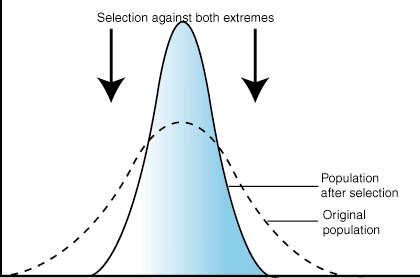
Stabilizing Selection Favors average traits and selects against extremes.
-
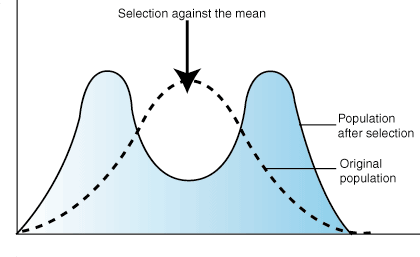
Disruptive Selection Favors both extremes of a trait and selects against the average. An example is Darwin's finches, where both large and small beaks were advantageous for survival, but medium-sized beaks were not.
Strengths of Darwin's theory
- Explains how species adapt to their environment.
- Provides a mechanism (natural selection) for how species evolve.
- Emphasizes the role of competition and variation in survival.
Weaknesses of Darwin's theory
- Did not explain how traits are inherited, as genetics was not understood at the time.
- Did not address mutations or genetic recombination as mechanisms for variation.
- Did not explain the origin of life, only how species evolved once life existed.
Neo-Darwinism is the modern version of Darwin's theory of evolution, which has been enhanced by evidence from various scientific fields, particularly genetics, molecular biology, ecology, palaeontology, and ethology. This theory explains the process of organic evolution through natural selection, but emphasizes the role of genetically determined traits and gene frequency changes in populations.
Key points of Neo-Darwinism
- Evolution occurs through genetic changes in populations.
- Natural selection acts on these genetic variations, selecting favorable genotypes and eliminating unfavorable ones, leading to the gradual change in species over time.
- Gene frequency in large populations shifts, with some traits becoming more common and others disappearing, ensuring that organisms better adapted to the environment survive and reproduce.
Evidence supporting Neo-Darwinism
- Genetic Recombination:
- In sexually reproducing organisms, genetic recombination occurs during meiosis. This leads to new combinations of genes, contributing to genetic diversity.
- This genetic variation can result in new traits that may be advantageous in the given environment, leading to better adaptation and survival.
- Over successive generations, these favorable traits can become more common in the population.
- Genetic Drift (Sewell Wright Effect):
- Genetic drift refers to random changes in gene frequencies due to chance events, such as migration or natural disasters that drastically reduce population size.
- Smaller populations are more prone to genetic drift, which can lead to the loss of certain traits or genetic variation.
- Sewell Wright first recognized that genetic drift could cause changes in gene frequencies and influence evolution.
- Natural Selection Natural selection is the process by which beneficial traits become more common in a population, while detrimental traits are eliminated.
The following examples illustrate how natural selection operates:
Industrial Melanism in Peppered Moths (Biston betularia):
- In the 19th century, the light-colored moths were more common because they were camouflaged on light-colored tree trunks. However, industrial pollution darkened the tree trunks, making the light-colored moths more visible to predators.
- The darker moths, which blended in with the soot-covered trees, had a survival advantage, leading to an increase in their population. This is a clear example of natural selection favoring darker moths in polluted areas.
Pesticide Resistance in Insects (DDT):
- When DDT (a pesticide) was used to kill mosquitoes, most were killed, but some mosquitoes were genetically resistant to the pesticide. These resistant mosquitoes survived and reproduced, leading to a population of mosquitoes that could resist DDT.
- This process is an example of natural selection acting on genetic variation, with the resistant mosquitoes being favored by the selection pressure (DDT).
Strengths of Neo-Darwinism
- The theory incorporates the role of genetics in the process of evolution, making it more scientifically robust.
- It effectively explains micro-evolution (small changes within a species), such as the development of pesticide resistance or changes in gene frequencies.
- The theory offers clear examples of how natural selection operates through genetic variation and adaptation.
Weaknesses of Neo-Darwinism
- While Neo-Darwinism explains how traits are selected over time, it does not fully explain the origin of new species or organisms with distinct forms and behaviors. The origin of novel species remains an area of uncertainty.
- The theory primarily explains micro-evolution but is limited in addressing macro-evolution (large-scale changes leading to the emergence of new species).
- Neo-Darwinism assumes that genetic variations are random, but modern genetics suggests that mutations can be directed and adaptive in response to environmental pressures, which may result in the creation of new species.
Mwalimu
Unasoma somo hili? Niulize nikuelezee chochote kilichomo.
Ingia ili kumuuliza Mwalimu wa AI wa Sonza kuhusu mada hii.
Ingia ili kuuliza