Mada za sehemu hiiThe Earth As A SphereMada 3
- Features and location of places
- Distances along great circles
- Distances along small circles
The Equator, Great Circle, Small Circles, Meridian, Latitudes and Longitudes
The Earth is not a perfect sphere, as it is slightly flatter at the north and south poles than at the equator. But for most purposes we assume that it is a sphere.
The position of any point on earth is located by circles round the earth, as follows:
The earth rotates about its axis, which stretches from the north to the south pole.
Circles round the Earth perpendicular to the axis are circles of latitude and circles round the Earth which go through the poles are circles of longitude or meridians.
Consider the following diagram
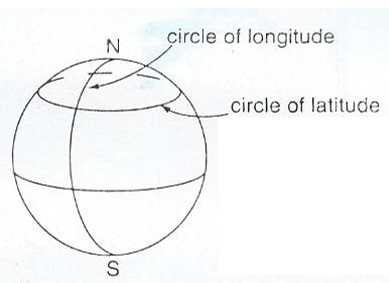
Normally latitude is defined relative to the equator, which is the circle of latitude round the middle of the Earth while longitude is defined relative to the circle of longitude which passes through Greenwich in London (Greenwich meridian).
The latitude of a position tells us how far north or south of the equator it is while the longitude of a position shows us how far east or west of the Greenwich meridian it is.
Latitude
If we draw a line from the centre of the Earth to any position P, then the angle between this line and the plane of the equator is the latitude of P.
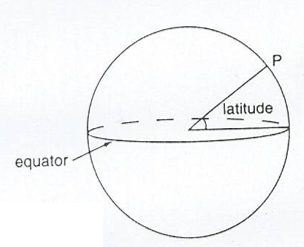
Longitude
This is the angle between the plane through the circle of any longitude P and the plane of the Greenwich meridian.
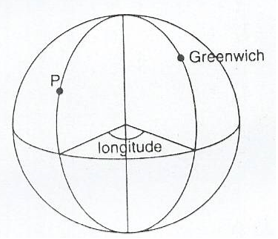
Latitude can be either north or south of the equator while longitude can be either east or west of Greenwich.
When locating the latitude and longitude of a place we write the latitude first then longitude.
Dar es Salaam has latitude 7°S (i.e. 7° south of the equator) and longitude 39°E (i.e. 39° east of the Greenwich meridian). So Dar es Salaam is at (7°S, 39°E).
Note: Greenwich itself has latitude 51°N (i.e. 51° north of the equator) and longitude 0° (by definition). Johannesburg has latitude 26°S (i.e. 26° south of the equator) and longitude 28°E (i.e. 28° east of the Greenwich meridian), therefore Johannesburg is at (26°S, 28°E). The north pole has latitude 90°N but its longitude is not defined (every circle of longitude goes through the north pole). The south pole has latitude 90°S. Its longitude is not defined. So all points on the equator (such as Nanyuki in Kenya) have latitude 0°.
Ranges; latitude varies between 90°S (at the south pole) to 90°N (at the north pole).
Ranges; longitude varies between 180°E and 180°W. These are the longitudes on the opposite side of the Earth from Greenwich.
There is an essential difference between latitude and longitude. Circles of longitude all have equal circumference. Circles of latitude get smaller as they approach the poles. The centre of a circle of longitude is at the centre of the earth. They are called great circles. For circles of latitude, only the equator itself is a great circle. Circles of latitude are called small circles.
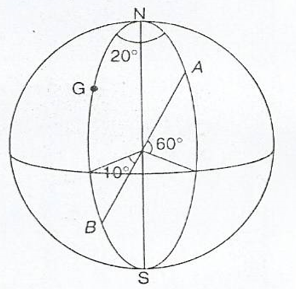
Find the latitudes and longitudes of A and B on the diagram below:
Solution:
The point A is 60° above the equator, and 20° east of Greenwich. Therefore, the coordinates of A are (60°N, 20°E).
The point B is 10° below the equator, and on the Greenwich meridian. Therefore, the coordinates of B are (10°S, 0°).
Suppose two places have the same longitude but different latitudes. Then they lie north and south of each other.
- If both points are south of the equator: subtract the latitudes.
- If both points are north of the equator: subtract the latitudes.
- If one point is south and the other north: add the latitudes.
Suppose two places have the same latitude but different longitudes:
- If both points are east of Greenwich: subtract the longitudes.
- If both points are west of Greenwich: subtract the longitudes.
- If one point is east and the other west: add the longitudes.
Suppose places A and B are on the same longitude. Then the difference in latitude is the angle subtended by AB at the centre of the Earth.
Suppose places A and B are on the same latitude. Then the difference in longitude is the angle subtended by AB on the Earth's axis.
Three places on longitude 30°E are:
- Alexandria (in Egypt): (31°N, 30°E)
- Kigali (in Rwanda): (2°S, 30°E)
- Pietermaritzburg (in South Africa): (30°S, 30°E)
Find the difference in latitude between:
- Kigali and Pietermaritzburg Both towns are south of the equator, so subtract the latitudes: 30° – 2° = 28° The difference is 28°.
- Kigali and Alexandria Kigali is south of the equator and Alexandria is north, so add the latitudes: 31° + 2° = 33° The difference is 33°.
A plane starts at Chileka Airport (in Malawi) which is at (16°S, 35°E). It flies west for 50°. What is its new latitude and longitude?
Solution:
Since the plane flies west, subtract 35° from 50°: 50° – 35° = 15°
The new longitude is west of Greenwich, so the coordinates become (16°S, 15°W).
Mwalimu
Unasoma somo hili? Niulize nikuelezee chochote kilichomo.
Ingia ili kumuuliza Mwalimu wa AI wa Sonza kuhusu mada hii.
Ingia ili kuuliza