Mada za sehemu hiiPrinciples Of ClassificationMada 5
- The concept of classification
- Classification systems
- Categories of classification
- Nomenclature
- Taxonomic keys
Classification is the process of classifying or systematic arrangement of animals and plants in groups or categories according to established criteria
There are few terms which come across when studying classification. These terms include systematic, taxonomy, classification and nomenclature.
To understand the principles used in classification these terminologies need to be clearly defined.
Systematic is a branch of biological science that deals with the study of the kinds of diversity of all organisms and their relationship.
The term systematic is derived from the Greek word 'system' which simply means 'that which is put together'.
Significance of systematic
Systematic gives the idea of organic diversity, its origin and evolution in the various kingdoms.
- It helps in identification of living organisms.
- It simplifies the study of biology.
- It makes biology communication easier e.g. nomenclature.
- It group together biology knowledge.
- It helps us to understand the relationship between the organisms and their environment.
The subject is relevant to all sector of applied biology such as agriculture, forestry, medicine, fisheries and conservation of natural resources.
Systematic include taxonomy, identification, classification and nomenclature.
Identification is the part of taxonomy that assigns an organism to its correct taxon.
It involves describing an organism using evidence from other branches of biology e.g. cytology, biochemistry, anatomy, ecology or morphology.
Example of identification
Consider three animals such as a, b and c. all belonging to different species. Another animal d having resemblance with animal b. The recognition of animals which is identical or similar to the already known animal b is considered its identification.
NB: much evidence need to be collected in order to assign a particular organism in a certain group.
Identification is done by using identification key/ biological key.
This refers to a schedule of characteristics data which can be matched or correlated with observable characteristics of an organism so as to identify it.
Or
A set of observable characteristics that leads to the identification of an unknown organism
Importance of the biological key
Provide a convenient method which enable biologists to identify an organism and allocate different organisms in their correct taxa or group or more useful in identification of unknown organisms.
Types of biological key
There are two types of key;
- Indented key.
- Bracketed key.
i. Indented key; this is the type of key which provides sequence of choices between two or more statements of characters of species. The use has to make a correct choice for identification
Example of indented key
| Character | |
|---|---|
| Carpel. | Single-ovuled, fruit achene, leaves opposite, compound petals absent. Leaves with tendrils Clematis. |
| Petals present third or terminal leaf let modified into tendrils naravelia. | |
| Leaves alternate or radicle anemone | |
| Many - ovules; fruit follicle, carpel united at base; | |
| Flowers regular nigella | |
| Carpel free at base; flower irregular Aconitum |
ii. Bracketed
This type of key provides a choice between two contrasting statements which lead into accepting one statement and rejecting the other.
The word dichotomous means - separating or branching into two.
There are two types of dichotomous key
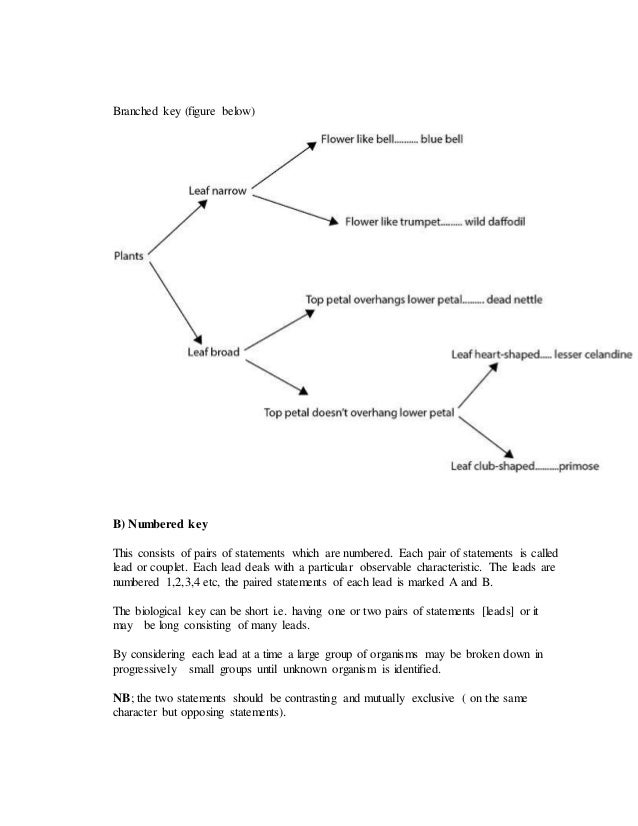
Branched key -this is diagrammatically represented. The key form two branches at each stage. This means that one is confronted with two possibilities at each stage. The description which fits the member of each new group is put at the end of new branch.
The problem of branched key is that they take up much space particularly if many organisms are involved
Branched key (figure below)
ii. Numbered key
This consists of pairs of statements which are numbered. Each pair of statements is called lead or couplet. Each lead deals with a particular observable characteristic.
The biological key can be short i.e. having one or two pairs of statements or it may be long consisting of many leads.
NB; the two statements should be contrasting and mutually exclusive (on the same character but opposing statements).
A dichotomous key is a tool used by biologists and taxonomists to identify and classify organisms based on a series of contrasting morphological characteristics. The key consists of a sequence of paired statements (called couplets), each of which narrows down the possible identity of the organism.
1. Base the key on observable morphological characteristics
Use morphological features that are visible and measurable (e.g., flower color, leaf shape, presence of wings, body segmentation). The more characteristics you use, the more accurate the identification process becomes.
2. Use mutually exclusive character states
Each step in the key should consist of two opposing statements that represent contradictory alternatives. One statement must apply to the organism, and the other must clearly not. For example:
- Leaves are needle-like
- Leaves are broad and flat
3. Consider one character at a time
Construct the key by examining and organizing one characteristic per step, and number each decision point sequentially (e.g., 1, 2, 3...).
4. Phrase statements positively
Whenever possible, use positive phrasing, especially for the first statement in each pair. This makes the key easier to read and follow.
- Correct: a) Flower is scented
- Incorrect: a) Flower is not unscented
5. Use parallel and consistent language
Both contrasting statements in a couplet should begin with identical or parallel wording to maintain clarity and flow.
Example:
- Leaves are arranged alternately on the stem
- Leaves are arranged oppositely on the stem
6. Favor macroscopic over microscopic features
Where possible, use macroscopic characteristics (visible to the naked eye) instead of microscopic traits. This increases the accessibility of the key to general users.
7. Avoid vague or overlapping descriptions
Ensure statements are precise and non-overlapping. Avoid general terms that can be interpreted in different ways. Be specific to prevent ambiguity.
Example:
- Specific: Plant height 1 meter or more
- Specific: Plant height between 15 cm and 60 cm
- Vague: Plant is short or tall
Study the morphological characters of the organisms provided and prepare a table of differences and similarities in characters.
Use the data you have tabulated to construct a dichotomizing tree of characteristics.
Example
Given the following plant leaves, construct the dichotomous key to identify them:
Step 1: List down the characteristics
Pay attention to the specimens you are trying to identify with your dichotomous key. List down the characteristics that you can notice. For example, say you are trying to classify a group of animals. You may notice that some have feathers whereas others have legs, or some have long tails and others don't.
Step 2: Organize the characteristics in order
When creating your dichotomous key, you need to start with the most general characteristics first, before moving to the more specific ones. So it helps to have identified the more obvious and less obvious contrasting characteristics among the specimen before creating your dichotomous key.
Step 3: Divide the specimens
You can use statements (i.e. has feathers and no feathers) or questions (does it have feathers?) to divide your specimens into two groups. The first differentiation should be made on the most general characteristic.
Step 4: Divide the specimen even further
Based on the next contrasting characteristic, divide the specimen further. For example, first, you may have grouped your animals as have feathers and have no feathers, in which case the ones with feathers can be categorized as birds while you can further subdivide the ones that have no feathers as having fur and having no fur. Continue to subdivide your specimen by asking enough questions until you have identified and named all of them.
Step 5: Draw a dichotomous key diagram
You can either create a text-based dichotomous key or a graphical one where you can even use images of the specimen you are trying to identify. Here you can use a tree diagram or a flowcharts as in the examples below.
Step 6: Test it out
Once you have completed your dichotomous key, test it out to see if it works. Focus on the specimen you are trying to identify and go through the questions in your dichotomous tree to see if you get it identified at the end. If you think the questions in your dichotomous key needs to be rearranged, make the necessary adjustments.
- Consider only one characteristic at a time
- Use morphological or observable characteristics as much as you can
- Use major characteristics when dividing the organisms in the beginning and use lesser or less obvious characteristics to divide them into smaller groups
- When writing contrasting statements, rely on similar word formats (i.e. have feathers and don't have feathers)
- Be specific in your statements and avoid repeating the same characteristics
- Use questions that lead to yes or no answers rather than statements
- Observable e.g. morphological features
- Quantity e.g. number of hairs, legs, wings etc.
- Qualitative e.g. shape of abdomen.
Mwalimu
Unasoma somo hili? Niulize nikuelezee chochote kilichomo.
Ingia ili kumuuliza Mwalimu wa AI wa Sonza kuhusu mada hii.
Ingia ili kuuliza