Mada za sehemu hiiCarboxylic Acida And DerivativesMada 2
- Carboxylic Acids
- Esters
Carboxylic acids and their derivatives
Carboxylic acids are organic compounds that contain a carboxyl group (-COOH) as the functional group. They can be either aliphatic or aromatic in nature. The carboxyl group is a combination of a carbonyl group (C=O) and a hydroxyl group (–OH).
- Example i)
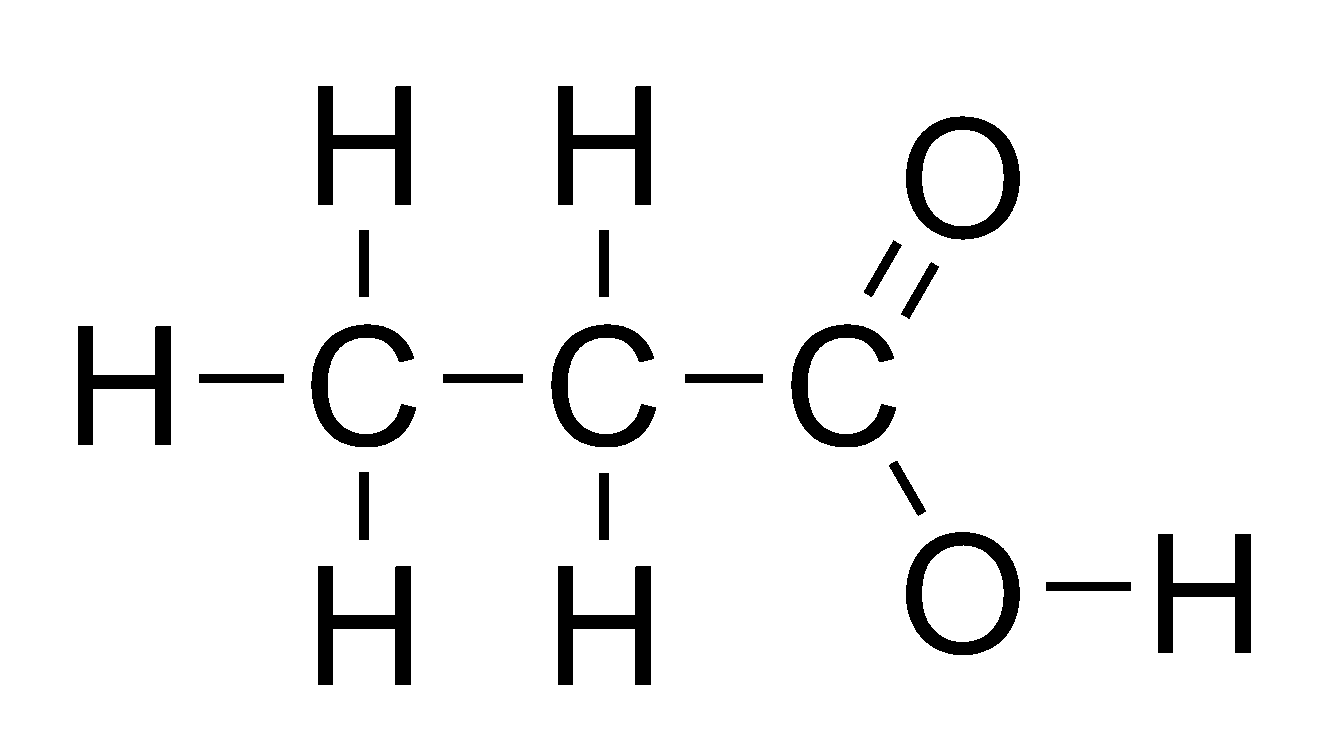 Propanoic acid
 - Example ii)
 3-Pentanoic acid or Pent-3-enoic acid
 - Example iii)
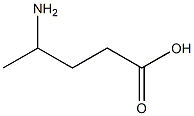 4-Aminopentanoic acid
i. Oxidation
a) Oxidation of Alcohol: Alcohols can be oxidized using strong oxidizing agents like or KMnO4 to produce carboxylic acids. The oxidation of ethanol (C2H5OH) to acetic acid (CH3COOH) is an example:
C2H5OH+→CH3COOH
b) Oxidation of Carbonyl Compounds: Aldehydes are easily oxidized to carboxylic acids, whereas ketones resist oxidation but can form carboxylic acids under drastic conditions. For example, oxidation of acetaldehyde (CH3CHO) to acetic acid (CH3COOH):
CH3CHO+→CH3COOH
Note: Methanoic acid cannot be prepared through oxidation as it can further be oxidized to carbon dioxide.
ii. Hydrolysis
Acyl compounds can be hydrolyzed to give carboxylic acids. For example, hydrolysis of an ester (ethyl acetate) gives acetic acid:
CH3COOCH2CH3+H2O→CH3COOH+CH3CH2OH
iii. Formation via Grignard Reagent
Carbon dioxide reacts with a Grignard reagent (e.g., methylmagnesium bromide) followed by acidic hydrolysis to form carboxylic acids:
CH3MgBr+CO2→CH3COOH (after hydrolysis)
Carboxylic acids have the highest boiling points compared to alcohols, phenols, and other carbonyl compounds due to strong hydrogen bonding between their molecules. They also undergo dimerization in non-polar solvents due to these interactions:
2RCOOH⇌(RCOOH)2
Acidic behavior of carboxylic acids
Carboxylic acids are stronger acids than alcohols and phenols. The acidic strength depends on the length of the carbon chain and the type of substituents present in the carboxyl group. For example, acetic acid (CH3COOH) dissociates as follows:
CH3COOH⇌CH3COO−+H+
When a strong electronegative substituent like halogens is present, the acidic strength increases due to the negative inductive effect that stabilizes the carboxylate ion:
CH3COOH+X−→CH3COO−+HX
i. Reaction with sodium bicarbonate
Carboxylic acids react with sodium bicarbonate to release carbon dioxide gas, which turns lime water milky. The general reaction is:
RCOOH+NaHCO3→RCOONa+CO2+H2O
ii. Reaction with alkali
Carboxylic acids react with alkali to form salts and water. For example, acetic acid reacting with sodium hydroxide:
CH3COOH+NaOH→CH3COONa+H2O
iii. Reaction with strong metals
Carboxylic acids react with strong metals to produce carboxylate salts and hydrogen gas. For example, reaction with sodium:
2CH3COOH+2Na→2CH3COONa+H2
a. Halogenation
Carboxylic acids react with halogenating agents like PX5, PX3, and SOX2 to form acyl halides. For example, the reaction of acetic acid with phosphorus trichloride (PCl3):
CH3COOH+PCl3→CH3COCl+POCl2+HCl
b. Reaction with alcohol (ester formation)
Carboxylic acids react with alcohols in the presence of sulfuric acid to form esters. For example, the reaction of acetic acid with ethanol:
CH3COOH+C2H5OH→CH3COOC2H5+H2O
i. Reaction with alcohol
Carboxylic acids react with alcohols in the presence of an acid to form esters, which helps distinguish them from phenols, which do not react with alcohols.
ii. Reaction with sodium bicarbonate
Carboxylic acids react with sodium bicarbonate to produce effervescence of carbon dioxide gas, which turns lime water milky.
iii. Ferric chloride test
Carboxylic acids react with ferric chloride to form an iron (III) carboxylate, which appears as a buff-colored compound. This reaction is used to distinguish carboxylic acids from alcohols and phenols. For example, reaction with ferric chloride (FeCl3):
RCOOH+FeCl3→Fe(RCOO)3+3HCl
iv. Formation of ester
Acyl chloride reacts with phenol in the presence of a catalyst to form esters. For example:
CH3COCl+C6H5OH→C6H5COOCH3+HCl
Mwalimu
Unasoma somo hili? Niulize nikuelezee chochote kilichomo.
Ingia ili kumuuliza Mwalimu wa AI wa Sonza kuhusu mada hii.
Ingia ili kuulizaMajadiliano
Hakuna maswali bado