Mada za sehemu hiiAliphatic HydrocarbonsMada 5
Alkanes: nomenclature, preparation, properties, and uses
Alkanes, also called saturated hydrocarbons, are the simplest class of organic compounds, consisting only of carbon (C) and hydrogen (H) atoms, bonded by single covalent bonds. They are called "saturated" because each carbon atom forms the maximum number of bonds with hydrogen atoms. The general formula for alkanes is , where "n" represents the number of carbon atoms.
Nomenclature of alkanes
Alkanes are named based on the number of carbon atoms they contain, with the suffix "-ane." Below are examples for the first ten alkanes:
- 1 carbon - Methane ()
- 2 carbons - Ethane ()
- 3 carbons - Propane ()
- 4 carbons - Butane ()
- 5 carbons - Pentane ()
- 6 carbons - Hexane ()
- 7 carbons - Heptane ()
- 8 carbons - Octane ()
- 9 carbons - Nonane ()
- 10 carbons - Decane ()
Nomenclature of branched alkanes
When alkanes contain branching in their carbon chains, their names are derived using a systematic naming convention called the International Union of Pure and Applied Chemistry (IUPAC) system. This system ensures that each compound has a unique and universally understood name.
The key steps in naming branched alkanes are:
- Identify the longest continuous carbon chain: The longest chain will determine the parent name of the alkane. This chain must include the branch point(s).
- Number the carbon atoms in the longest chain: The chain is numbered starting from the end nearest to the branch (substituent). If the branches are equidistant, the numbering should give the lower number to the substituent that comes first alphabetically.
- Identify and name the substituents: Groups attached to the main chain are called substituents. Each substituent gets a prefix (e.g., methyl, ethyl, propyl) and a number indicating its position on the chain.
- Combine the name of the substituent with the parent chain name: The names of the substituents are listed in alphabetical order, with their position numbers placed before them. Multiple substituents of the same type are indicated with prefixes like di-, tri-, etc.
Example 1: 2-Methylpropane (Isobutane)
In this case, the longest chain consists of 3 carbon atoms, which gives the base name "propane." There is a methyl group () attached to the second carbon in the chain, so the name is 2-methylpropane.
= 
Example 2: 3-Ethylpentane
Here, the longest chain has 5 carbon atoms, which gives the base name "pentane." An ethyl group () is attached to the third carbon in the chain. Therefore, the IUPAC name is 3-ethylpentane.
= 
Example 3: 2,3-Dimethylbutane
This molecule has a 4-carbon chain (butane) with two methyl groups () attached at the second and third positions, so its IUPAC name is 2,3-dimethylbutane.
= 
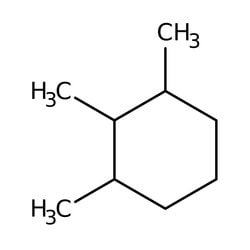
Example 4: 1,2,3-Trimethylcyclohexane
This compound is a cyclic alkane (cyclohexane) with three methyl groups attached at positions 1, 2, and 3 of the six-membered ring. The IUPAC name is 1,2,3-trimethylcyclohexane.
= 
Rules for naming branched alkanes
- If the chain has multiple branches, number the positions in the chain to give the lowest possible numbers to the substituents.
- When two or more substituents are attached at the same position, use prefixes such as "di-" for two, "tri-" for three, etc.
- In cases where there are multiple substituents of different types, list them in alphabetical order (ignoring any prefixes like "di-" or "tri-").
Examples of branching structures
Example 1: 2-Methylpentane
This molecule has a 5-carbon chain (pentane) with a methyl group () attached at the second position.
= 
Example 2: 3-Ethyl-2,4-dimethylpentane
In this example, the parent chain is pentane (5 carbons), with an ethyl group () attached to carbon 3, a methyl group attached to carbon 2, and another methyl group attached to carbon 4.
=
Important notes
- Branching impact: Branched alkanes often have lower boiling points than their straight-chain isomers because the branching decreases the surface area and reduces the intermolecular forces.
- Isomerism: Branched alkanes can have structural isomers where the atoms are arranged differently. This is a key feature in organic chemistry and requires students to become familiar with recognizing and naming various isomers.
Methods of preparation of alkanes
(a) Hydrogenation of alkenes and alkynes
Alkanes can be synthesized from alkenes and alkynes by hydrogenation, a reaction where hydrogen () is added across the double or triple bond, in the presence of a catalyst such as Nickel (Ni) or Platinum (Pt), at temperatures around 200°C to 300°C:
In this example, ethene () reacts with hydrogen to form ethane ().
(b) Reduction of alkyl halides
Alkyl halides (haloalkanes) can be reduced to alkanes using zinc and acid, or in the presence of zinc and copper with alcohol.
-
Reduction by Zinc and Acid: Zinc metal displaces the halogen from the alkyl halide:
-
Reduction by Zinc and Copper with Alcohol: Zinc and copper act as reducing agents in the presence of alcohol to reduce the alkyl halide.
-
Reduction by Hydroiodic Acid (HI): Hydroiodic acid reduces alkyl halides when heated with red phosphorus.
(c) Wurtz synthesis
Wurtz synthesis involves the reaction of alkyl halides with sodium metal in dry ether to form alkanes. The product will have twice the number of carbon atoms as the alkyl halide:
(d) Decarboxylation of sodium carboxylate salt
Alkanes can be obtained by decarboxylation, where carboxylate salts react with sodium hydroxide in the presence of calcium oxide to release a molecule of carbon dioxide and form alkanes:
(e) Cracking
Cracking is the process of breaking down large molecules into smaller molecules. This occurs in the refining of petroleum. The two types of cracking are:
- Thermal Cracking: Large molecules are heated to break bonds.
- Catalytic Cracking: A catalyst speeds up the cracking process, converting large alkanes into smaller alkanes and alkenes.
(f) Preparation from alcohols
Alkanes can also be prepared by reducing alcohols. When alcohols react with hydroiodic acid (HI) and red phosphorus, they are converted into alkanes:
Physical properties of alkanes
(a) Boiling and melting points
Alkanes have low boiling and melting points because they are non-polar molecules, which results in weak van der Waals forces between molecules. As molecular size increases, so do the boiling and melting points.
- Methane () has a boiling point of −161.5°C.
- Decane () has a boiling point of 174°C.
Branched-chain alkanes have lower boiling points than straight-chain alkanes of the same molecular mass because their compact structure reduces the surface area, which weakens the intermolecular forces.
(b) Solubility
Alkanes are insoluble in water because they are non-polar. However, they are soluble in other non-polar solvents such as benzene, ether, and chloroform.
Chemical properties of alkanes
Alkanes are relatively non-reactive because they do not have functional groups and their C–C and C–H bonds are strong. However, they can undergo certain reactions:
(a) Substitution reactions
Alkanes can undergo halogenation, where a halogen atom (like chlorine) replaces a hydrogen atom in the presence of ultraviolet (UV) light:
(b) Oxidation reactions
When alkanes burn in excess oxygen, they undergo combustion, producing carbon dioxide () and water () as products:
(c) Thermal decomposition (cracking)
In the absence of oxygen, alkanes can undergo thermal decomposition, or cracking, where they break down into smaller alkanes and alkenes:
(d) Catalytic cracking
In catalytic cracking, alkanes are heated in the presence of a catalyst (e.g., aluminum chloride, ) to form branched-chain isomers, which are more desirable for gasoline production.
Uses of alkanes
- Fuel: Alkanes such as methane, propane, and butane are commonly used as fuels in natural gas and liquefied petroleum gas (LPG).
- Solvents: Low-boiling alkanes like hexane are used as industrial solvents.
- Lubricants: Heavier fractions of petroleum are used as lubricants and to produce waxes and Vaseline.
- Detergents: Cracked products like linear alkylbenzene (LAB) are used in the manufacturing of detergents.
Mwalimu
Unasoma somo hili? Niulize nikuelezee chochote kilichomo.
Ingia ili kumuuliza Mwalimu wa AI wa Sonza kuhusu mada hii.
Ingia ili kuulizaMajadiliano
Hakuna maswali bado